
Hallux Rigidus (Hallux Limitus)
Hallux rigidus, or hallux limitus, is the medical term for arthritis of the big toe, a progressive deterioration of the cartilage within the joint.
So what is hallux rigidus exactly? The name itself provides a clue: “hallux” means big toe, and “rigidus” means stiff. In its earlier, less severe form the condition is known as hallux limitus (limited movement), and as stiffness worsens it progresses to full hallux rigidus (a rigid toe).
This condition affects the metatarsophalangeal (MTP) joint of the first ray, situated between the metatarsal bone and the phalanges of the big toe. As the cartilage wears away, bone rubs directly against bone, causing pain, increasing stiffness and a progressive loss of mobility. An arthritic big toe (hallux rigidus) can significantly impair walking and everyday comfort if left untreated.
Related treatment(s)
-
Hallux rigidus surgery
See the treatment in detail

Hallux Rigidus’ Causes
Hallux rigidus’ causes can sometimes be difficult to pinpoint. However, several factors are known to promote the onset and progression of this big-toe arthritis. Among patients with hallux limitus or hallux rigidus, the following are frequently identified:
- Repeated micro-trauma, particularly from high-impact sports that place heavy demands on the forefoot, such as running, dancing or football.
- A specific foot morphology known as the Egyptian foot, in which the big toe is longer than the other toes. This configuration increases pressure on the MTP joint, accelerating its deterioration.
- A history of local injury or infection at the big toe, such as a previous fracture.
- Regular wearing of unsuitable footwear, especially high heels or narrow shoes, which increase stress on the forefoot and restrict joint mobility.
Preventive Measures
Certain preventive measures can reduce the risk of developing hallux rigidus or slow its progression. It is advisable to:
- limit high-impact sports that generate repetitive loading (football, tennis, handball, etc.),
- favour gentler activities for the foot, such as swimming,
- wear shoes that provide adequate room for the forefoot,
- avoid high heels and excessively tight footwear wherever possible.
Hallux Limitus/Rigidus Diagnosis and Classification
Hallux limitus/rigidus diagnosis is based on a thorough medical assessment combining clinical examination and imaging, in order to confirm the condition and determine its precise stage.
The first step is a detailed clinical examination by a surgeon specialising in foot conditions. This allows assessment of:
- the range of motion of the big-toe MTP joint,
- the presence of joint stiffness,
- any deformity or pain provoked by movement.
When the clinical findings suggest hallux rigidus, imaging studies are requested. A weight-bearing foot X-ray is the reference investigation: it confirms the hallux rigidus diagnosis, reveals the extent of cartilage loss and establishes the stage of arthritis.
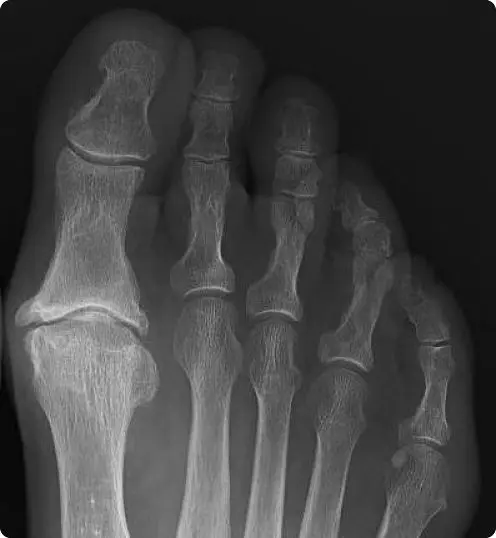
Where further detail on bone or cartilage involvement is needed, additional investigations may be proposed, such as:
- a CT scan,
- an MRI,
- an ultrasound,
- or a bone scan.
Hallux Rigidus Classification: Stages and Grades
A key part of the diagnosis is establishing where the condition sits within a recognised hallux rigidus classification system. Specialists use a grading scale that defines several hallux rigidus stages, typically ranging from mild to severe:
- Early stage: Mild cartilage wear with preserved joint space. The patient experiences occasional stiffness and discomfort, mainly during physical activity. This is sometimes described as early stage arthritis in feet. At this point, the condition is more accurately termed hallux limitus rather than full hallux rigidus, as the toe retains partial mobility.
- Moderate stage: Noticeable joint-space narrowing on X-ray, with the formation of bony spurs (osteophytes). Pain becomes more frequent, stiffness increases and a visible hallux rigidus bump may appear on the top of the toe.
- Severe stage: Extensive cartilage destruction, significant osteophyte formation and marked loss of motion. Pain is present during most activities and sometimes at rest. The joint may be virtually immobile.
Identifying the correct hallux rigidus grades is essential because it directly determines whether conservative management is appropriate or whether surgical intervention is required. This progressive, personalised approach ensures a reliable diagnosis and the most suitable treatment strategy.
Hallux Rigidus Symptoms
Hallux rigidus symptoms develop gradually, intensifying as the arthritis progresses, and can have a significant impact on walking and everyday comfort.
Three characteristic clinical features are typically observed:
- Pain in the big toe: localised at the MTP joint. It may be constant or appear during movement, particularly when walking. Pain is sometimes accompanied by a visible deformity, most often on the dorsal surface of the joint.
- Stiffness with functional impairment: discomfort typically arises during the push-off phase of the step. This functional hallux rigidus limitation can lead to compensatory changes in gait, with the patient turning the foot outward to avoid loading the hallux rigidus toe. Over time, these compensations may cause secondary pain in the foot, knee or back.
- Joint deformity with a bony bump: the MTP joint may develop an overgrowth of bone (osteophyte) forming a characteristic hallux rigidus bump on the top of the big toe. This prominence makes wearing tight or rigid shoes difficult, or even impossible.
As the condition progresses, joint stiffness increases. The patient finds it increasingly difficult to move the big toe, which can make walking particularly arduous. At this point, specialist medical management becomes essential.
Hallux Rigidus and Hallux Limitus: Premium Medical and Surgical Treatment
The therapeutic management of hallux rigidus and hallux limitus requires a highly individualised approach, transitioning from biomechanical stabilisation to precision surgical reconstruction based on the stage of joint degeneration.
Non-Surgical Treatments
In the management of hallux rigidus, non-surgical treatments are always the first step, particularly at the early stage (hallux limitus) and moderate hallux rigidus stages.
Several options may be proposed, alone or in combination:
- Footwear adaptation — wide shoes with a stiff sole to limit joint bending,
- Pain-relief medication,
- Joint injections (viscosupplementation, PRP, corticosteroids),
- Custom-made orthotic insoles,
- Physiotherapy and targeted rehabilitation exercises,
- Mesotherapy,
- Modification of sporting activity,
- Nutritional supplements or complementary treatments.
It is important to note that no non-surgical treatment can restore destroyed cartilage or correct an established deformity. However, these measures are often effective at easing symptoms, improving quality of life and slowing the progression of hallux rigidus, sometimes over the long term.
Surgical Treatments
When conservative treatments no longer provide adequate relief, or when joint stiffness becomes too disabling, surgery should be considered. The approach is always tailored to the hallux rigidus stages and to the patient’s individual profile.
The expert surgeons at International Elite Care offer personalised, premium care, taking into account the degree of arthritis, residual mobility and the patient’s functional expectations.
The surgical technique differs according to whether the hallux rigidus is moderate or advanced. Several procedures are available depending on the hallux rigidus grades:
In early-stage forms, simple debridement of the bony overgrowths (osteophytes) (known as a cheilectomy) may be sufficient to eliminate pain and restore improved mobility. In more advanced forms of big-toe arthritis where the first metatarsal is excessively long, a decompression osteotomy (Weil osteotomy) should be discussed. This technique reduces joint pressure and slows or even halts the progression of the arthritis.
There is currently no prosthetic implant that delivers satisfactory medium and long-term outcomes.
In severe-stage hallux rigidus, the reference procedure is arthrodesis: a surgical fusion of the MTP joint that permanently eliminates the painful movement. Arthrodesis involves:
- fixation of the joint using hardware (screws, plate, etc.),
- elimination of the joint movement responsible for pain,
- possible bone reshaping to restore harmonious anatomy.
This procedure can be performed using two modern approaches:
- a minimally invasive technique, with a limited incision of 3 to 4 cm,
- a percutaneous technique, using 3 micro-incisions of less than 2 mm, combined with intra-operative X-ray guidance.
Percutaneous surgery most often allows the procedure to be carried out on a day-case basis. The patient can return home the same day and continue recovery in a comfortable environment.
Anaesthesia Operative Comfort
The procedure is performed under regional anaesthesia, ensuring complete absence of pain during surgery. Regional anaesthesia offers several advantages:
- reduced side effects compared with general anaesthesia,
- greater post-operative comfort,
- prolonged pain relief after the procedure.
The aim of surgery is to eliminate pain, restore stable walking function and allow the patient to regain a satisfying quality of life, within a safe and controlled medical environment.
Hallux Rigidus: Recovery and Convalescence
After hallux rigidus surgery, recovery is generally progressive, well supervised and well tolerated. It allows a swift return to walking and daily activities under optimal comfort and safety conditions.
Immediate Post-Operative Period
Following the procedure, the patient can walk regardless of the type of operation performed. Therapeutic shoes prescribed by the surgeon are not always required; they provide added comfort and improved locomotion while reducing pain. Walking can resume from the first day, provided medical instructions are followed.
A post-operative dressing is applied and must be:
- changed every two days,
- kept dry,
- maintained until healing is complete.
Follow-up appointments are arranged with the International Elite Care surgeon to monitor healing, adjust care and ensure recovery is progressing well.
Returning to Activities
Rehabilitation exercises after hallux rigidus surgery are essential to facilitate a return to sport and movement. Thanks to minimally invasive and percutaneous techniques, recovery timelines are optimised:
- Driving: generally possible after a few days of convalescence,
- Return to sport: typically between one and three months, depending on the situation.
Each phase of recovery is individualised, according to the procedure performed, the initial hallux rigidus stage and the patient’s sporting activity. Rigorous follow-up supports a return to activities under the best possible conditions and delivers a lasting result, both functionally and in terms of walking comfort.
Hallux Rigidus – FAQ
What is hallux rigidus and how does it differ from hallux limitus?
Hallux rigidus and hallux limitus describe the same condition at different stages. Hallux limitus refers to the earlier phase, in which the big toe still retains some movement but is noticeably stiff. As cartilage loss progresses and the joint becomes increasingly rigid, the condition is termed hallux rigidus. Both fall within the same hallux rigidus classification, with treatment tailored to the specific hallux rigidus grades.
Can hallux rigidus worsen if I do not seek treatment?
Yes. Hallux rigidus is a progressive condition. Without appropriate management, stiffness and pain tend to worsen over time, eventually impairing walking and everyday comfort on a lasting basis. An early assessment often makes it possible to slow this progression and to put straightforward solutions in place.
Can I still walk normally with hallux rigidus?
In the early hallux rigidus stages, many patients maintain satisfactory walking through simple adaptations. However, as joint stiffness progresses walking becomes more difficult and can lead to painful compensations in the foot, knee or back. A specialist opinion helps to anticipate these issues.
Are hallux rigidus and sport compatible?
This depends on the hallux rigidus stage and the sport involved. Low-impact activities are generally better tolerated (swimming, cycling, walking on flat ground), while sports that place heavy demands on the forefoot may require adaptation or a temporary pause. Following appropriate treatment, a progressive and supervised return to sport is usually possible.
Is surgery always necessary for hallux rigidus?
No. Surgery is never proposed as a first-line option. It is only considered when medical treatments can no longer control the pain or when the functional limitation becomes too great.
Is the surgical procedure painful?
Current minimally invasive techniques, combined with regional anaesthesia, allow a comfortable experience. Post-operative pain is generally well controlled and closely monitored to ensure a smooth recovery.
Will I be able to resume an active life after treatment?
Yes. The goal of hallux rigidus treatment is to restore stable walking and everyday comfort. Recovery timelines vary depending on the treatment used, but modern techniques allow a progressive return to activities. Rehabilitation after surgery can further facilitate a comfortable return to daily life.
I live abroad, can my treatment be organised remotely?
Absolutely. International Elite Care regularly supports international patients. Pre-operative video consultations can be arranged, along with full coordination of the care pathway, from first contact through to follow-up after returning to your home country.
Surgeon performing the procedure

Full support
Take advantage of our all-in-one service: insurance, travel, post-operative follow-up, etc.
Ready to begin your care journey?