
Your Cheilectomy by Expert Surgeons
A cheilectomy is a targeted, joint-preserving surgery designed to relieve pain while maintaining the mobility of the joint. The expert surgeons at International Elite Care are highly experienced in this procedure and perform it under exacting safety conditions, ensuring a successful operation and optimal recovery.
Before the operation, a pre-operative consultation confirms the indication, reviews the imaging studies and answers the patient’s questions. For international patients, this step can be carried out via video consultation, allowing the medical stay to be organised under the best possible conditions.
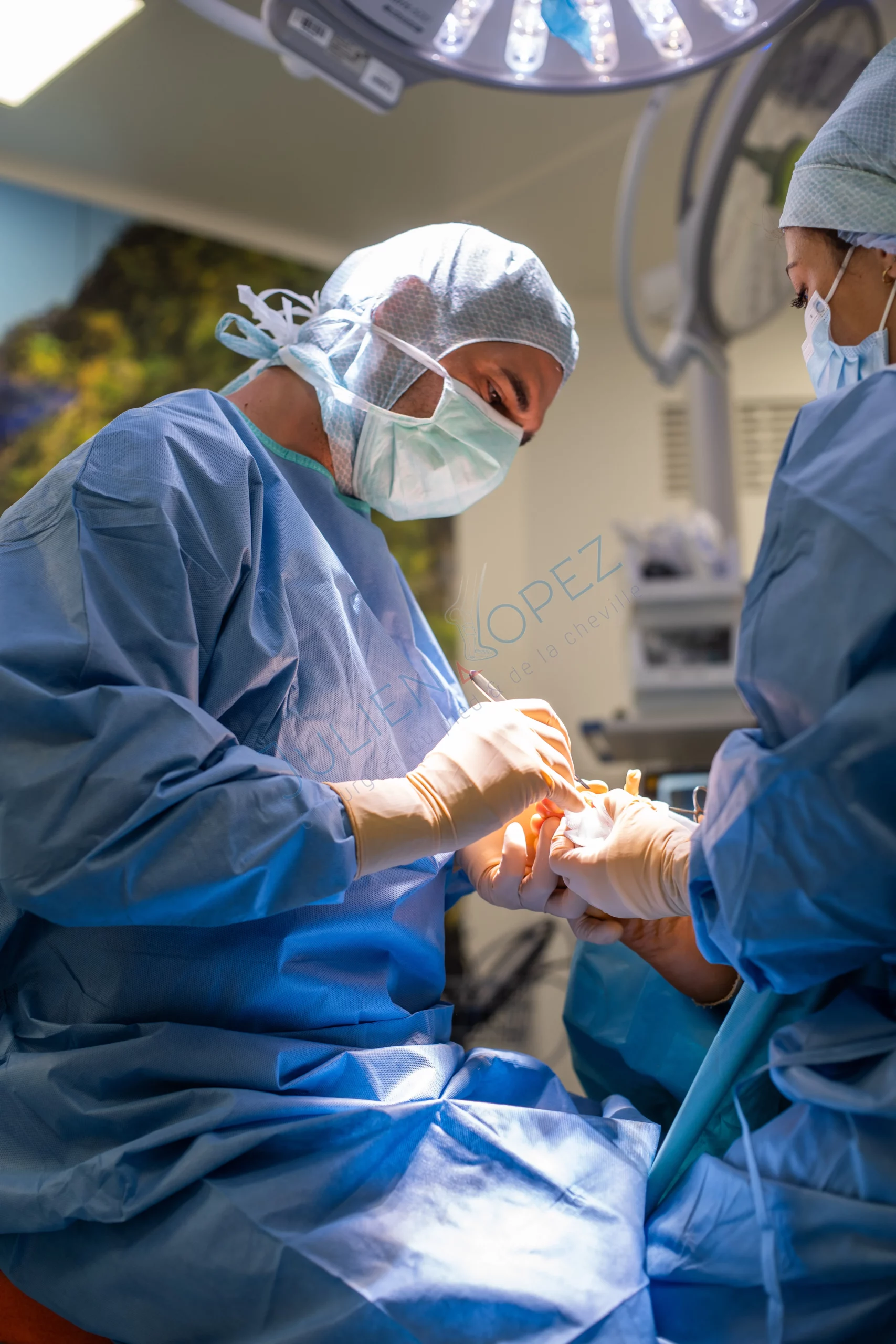
The cheilectomy operation is performed under local or regional anaesthesia, sometimes combined with light sedation. It lasts on average 30 to 45 minutes. The feet specialist accesses the joint at the base of the big toe through a small incision, then removes the bony spurs and the areas responsible for the blockage in order to free the joint’s movement.
In certain cases, a percutaneous cheilectomy may be offered. This approach, mastered by the International Elite Care surgeons, preserves the surrounding tissues more effectively while achieving the same goal of joint release.
After the procedure, careful closure is achieved with a discreet suture. The before and after cheilectomy scar is typically very small and fades well over time. Hospitalisation is most often on a day-case basis, allowing a swift return to your accommodation.
Cheilectomy Surgery: Definition and Indications
Cheilectomy surgery is an orthopaedic foot procedure designed to treat hallux rigidus — a progressive, painful stiffness of the joint at the base of the big toe.
By freeing the joint, the aim is to reduce pain, improve big-toe mobility and delay or avoid more extensive procedures such as arthrodesis (permanent joint fusion).
A 1st MTP cheilectomy is generally indicated when:
- pain becomes troublesome during everyday life or walking,
- stiffness limits the movement of the big toe,
- conservative treatments (adapted footwear, insoles, medication) are no longer sufficient,
- joint wear remains moderate to intermediate.
A metatarsophalangeal cheilectomy is a joint-preserving procedure. It is recommended for patients who wish to maintain the mobility of the joint while regaining better functional comfort.
Cheilectomy Success Rate and Expected Outcomes
The cheilectomy success rate is high when the indication is well established. In the majority of cases, the procedure markedly reduces the pain and discomfort associated with hallux rigidus. Improvement primarily concerns walking and shoe-wearing, and develops progressively over the weeks following the operation.
Improved Mobility
By freeing the joint at the base of the big toe, a 1st MTP joint cheilectomy restores more comfortable mobility, facilitating foot movement and the rolling motion of the step. The degree of improvement depends, however, on the extent of joint wear: the less advanced the damage, the better the result.
It is important to understand that a cheilectomy does not eliminate existing joint wear. When arthritis is more advanced, symptoms may progress over the long term.
Improved Everyday Comfort
Patients generally notice better functional comfort, with an easier return to daily activities and, in many cases, moderate sporting activities.
Cheilectomy Recovery Time
Cheilectomy recovery time is generally progressive and well tolerated, with shorter timelines than for more extensive foot procedures.
In the days following the operation, moderate pain and swelling can be expected. Fortunately, these are easily controlled with prescribed pain relief, and walking becomes possible quickly with an appropriate post-operative shoe.
Cheilectomy Recovery Timeline
The typical cheilectomy recovery timeline is as follows: normal activities can generally be resumed between 3 and 6 weeks after the procedure, and a return to sport is possible after 6 to 8 weeks, depending on progress and the type of sport.
The full results are appreciated after a few months, once the post-operative inflammation has completely resolved.
Recovery from Cheilectomy: Your Questions Answered
Recovery from cheilectomy raises many questions. The International Elite Care surgeons answer the most common ones below.
Is a cheilectomy really suited to my case?
The suitability of a cheilectomy depends primarily on the stage of hallux rigidus and the condition of the joint. A specialist consultation with our surgeons allows your imaging to be reviewed, your symptoms assessed and confirmation of whether this joint-preserving procedure is the most appropriate solution for your situation. At International Elite Care, this initial evaluation can often be carried out remotely
Is there such a thing as a cheilectomy for hallux valgus?
No. A cheilectomy is a procedure indicated for hallux rigidus, which involves painful stiffness of the joint at the base of the big toe. Hallux valgus (commonly called a “bunion”) is a deformity of the big toe that requires different surgical techniques.
Is the procedure painful?
A cheilectomy is performed under local or regional anaesthesia, so no pain is felt during the procedure. Afterwards, discomfort is easily managed with appropriate medication. Most patients describe a temporary inconvenience that diminishes progressively over the first weeks.
When can I walk and return to normal life?
Walking can resume quickly after the procedure with a post-operative shoe. Cheilectomy recovery allows everyday activities to be resumed progressively, with a return to normal life generally possible within 3 to 6 weeks, depending on individual progress.
Are the results long-lasting?
When performed at the right time, a cheilectomy provides lasting pain relief and improved walking comfort. It does not eliminate existing joint wear, but frequently delays — or even avoids — a more involved procedure such as arthrodesis.
Can a cheilectomy be performed on the ankle?
Yes, in certain cases a cheilectomy can be applied to the ankle joint to remove impinging bony spurs. Ankle cheilectomy recovery time is generally similar to that of the big toe, though it may vary depending on the extent of the procedure and the patient’s activity level. Your surgeon will advise on the expected timeline.
How much does a cheilectomy cost, and is it available on the NHS?
The cheilectomy cost in the UK varies depending on the surgeon and the facility. While a cheilectomy on the NHS may be available, waiting times can be significant. International Elite Care offers an alternative with rapid access to expert surgeons, transparent pricing and a bespoke care pathway. A personalised quotation is provided after your medical evaluation.
How is care organised from abroad?
International Elite Care supports you at every stage: pre-operative consultation (available via video call), referral to the most qualified and available surgeon, organisation of the medical stay and follow-up after your return home. This personalised support delivers a smooth, safe and premium care experience.
Surgeon performing the procedure


Full support
Take advantage of our all-in-one service: insurance, travel, post-operative follow-up, etc.