
PCL surgery: posterior cruciate ligament reconstruction
PCL surgery is a procedure designed to restore knee stability when the posterior cruciate ligament has been damaged or torn.
The PCL (posterior cruciate ligament) is one of the central ligaments of the knee. It stabilises the joint by keeping the tibia correctly positioned during movement and plays a key role in overall knee balance.
Dans certains cas, il est possible de soigner une rupture du ligament croisé postérieur sans chirurgie, par le biais d’un traitement conservateur (rééducation ciblée, renforcement musculaire, attelle). Cependant, si l’instabilité persiste ou si la lésion est importante, une intervention peut être recommandée.
Indications for posterior cruciate ligament surgery
Posterior cruciate ligament surgery is recommended when the injury causes significant knee instability and compromises normal joint function.
Understanding the PCL injury
A PCL tear typically occurs following a high-impact trauma:
- Contact sports (particularly rugby, through tackles or direct blows)
- Direct impact to the front of the tibia
- Road traffic accidents, especially motorbike collisions (dashboard-type impact)
The most common symptoms include:
- Knee swelling and reduced range of motion
- A feeling that the knee “gives way” when walking or going downstairs
- Difficulty with sports that require stability and changes of direction
In mild to moderate cases, conservative treatment (specialist rehabilitation, targeted muscle strengthening) may be sufficient.
In more severe cases, however, the torn ligament does not heal properly on its own, leaving the patient exposed to chronic instability and an increased risk of cartilage or meniscal damage.
Does a PCL tear require surgery?
Treating the posterior cruciate ligament with surgery is indicated in the following situations:
- Complete grade 3 tear with significant instability (differential laxity greater than 10 mm, clear sensation of instability during daily or sporting activities).
- Persistent instability after 6 months of well-conducted physiotherapy.
- Combined ligament injuries (for example, posterolateral corner involvement).
To address these complex cases, International Elite Care provides a specialist knee surgeon with expertise in arthroscopic reconstruction techniques. This minimally invasive approach allows for precise and effective management of combined PCL and posterolateral corner injuries.
Depending on the patient’s situation, the surgeon tailors:
- The surgical strategy
- The choice of reconstruction technique
- The rehabilitation protocol
- The timeline for return to sport
This way, you benefit from a rigorous and fully personalised care pathway.
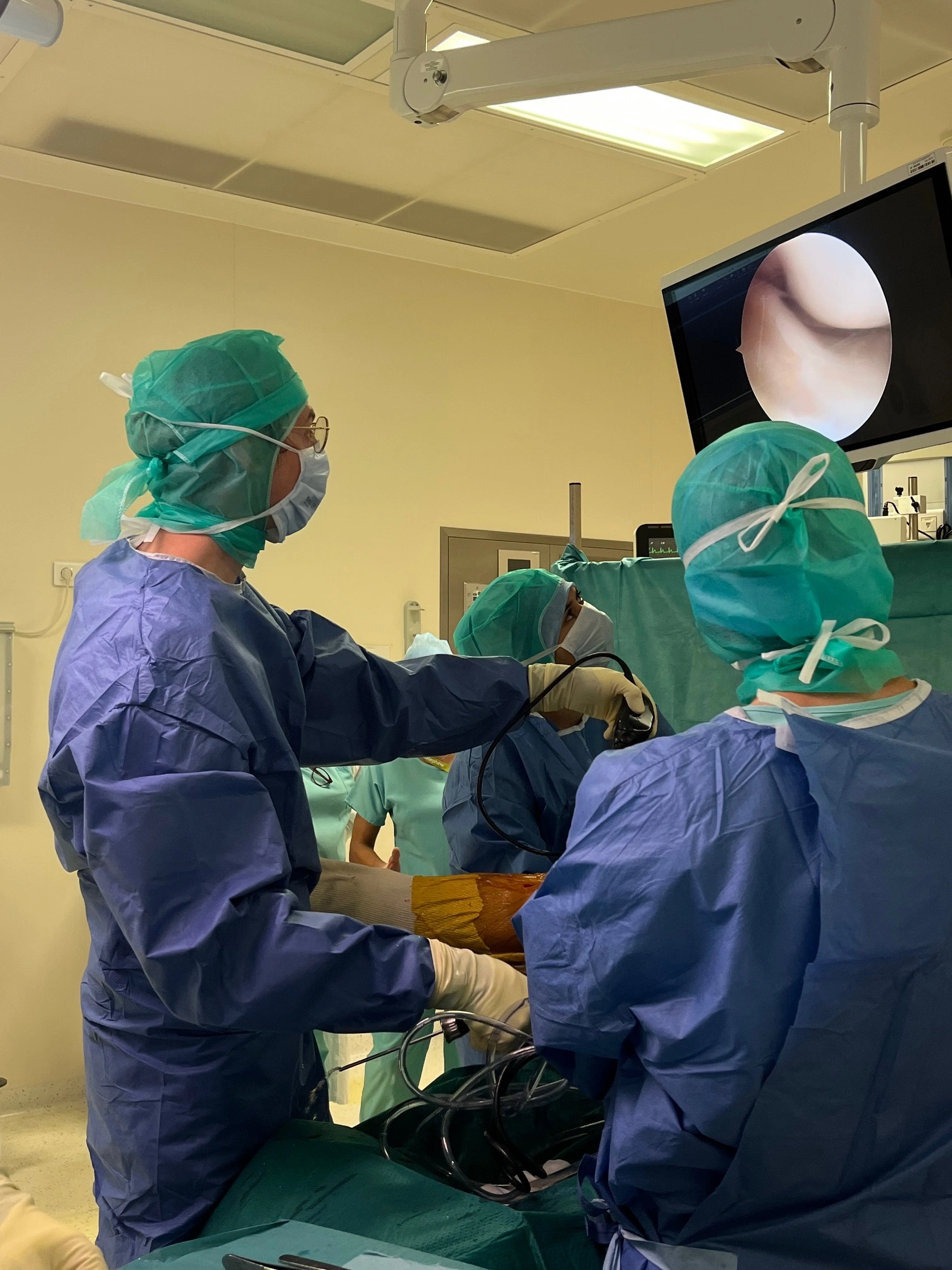
PCL tear surgery: the procedure in detail
PCL tear surgery involves reconstructing the damaged ligament using a graft, through modern, precise and minimally invasive techniques.
For the best possible outcomes, the surgeon at International Elite Care defines the surgical strategy according to each patient’s profile. The goal is to ensure a safe return to sport and daily activities, supported by structured follow-up at every stage.
PCL reconstruction surgery is performed under arthroscopy (camera-assisted surgery), through small incisions. This allows for exceptional surgical precision and optimises recovery.
Le greffon (tendon utilisé pour reconstruire le ligament) est préparé avec précision et trempé dans une solution antibiotique afin de réduire le risque infectieux.
Under arthroscopic guidance, tunnels are drilled into the tibia and femur. Their positioning is fundamental to accurately reproducing the natural anatomy of the ligament.
The graft is placed in the exact position of the original PCL to restore the normal biomechanics of the knee.
Fixation is achieved using interference screws. This dual-security approach ensures immediate stability of the construct.
Thanks to this modern approach:
- Anatomical precision is maximised
- Surrounding tissues are preserved
- Implanted material is kept to a minimum
- Complications are reduced
- Functional recovery is facilitated
The aim of PCL ligament surgery is not simply to reconstruct a ligament, but to give the patient a stable, reliable, long-lasting and high-performing knee. In addition, the use of minimally invasive techniques helps reduce the size of PCL surgery scars.
PCL surgery recovery time and expected results
Understanding the PCL surgery recovery time is essential for patients preparing for this procedure. After posterior cruciate ligament surgery, the success of the intervention depends as much on surgical precision as on the quality of post-operative rehabilitation.
With the structured and rigorous care provided by International Elite Care, the majority of patients regain satisfactory stability and can gradually return to their daily and sporting activities.
During this early phase of recovery time for PCL surgery, the priority is patient recovery and joint protection. It is essential to follow these precautions:
- PRICE protocol: protection, rest, ice, compression, elevation
- No posterior tibial translation for 12 weeks
- No specific hamstring strengthening before week 16
- Partial weight-bearing with crutches for 3 weeks
After PCL surgery, the leg must be immobilised for 21 days (day and night). This is achieved by wearing a brace locked in extension (straight leg). A functional knee brace can then be used afterwards.
One important precaution following PCL repair surgery concerns hyperextension. For the first 12 weeks after the procedure, no extreme movements should be performed with the knee, as the joint is not yet ready to withstand them.
At this stage, the goal is to protect the graft, reduce post-operative swelling and activate the quadriceps early, while maintaining a correct walking pattern. Weaning off crutches begins from the third week.
This phase focuses on recovering mobility and progressive knee strengthening. As a precaution, full range of motion is permitted without forced flexion, and hyperextension remains contraindicated. Hamstring exercises are still prohibited before 16 weeks and the brace is maintained.
During this phase, the objective is to gradually regain full range of motion without pain and normalise walking. The focus also turns to building muscular endurance and performing controlled strengthening of both legs (flexion limited to 70°).
Pool-based exercises, stationary cycling (no resistance from 115° of flexion) and progressive leg press or guided squat work allow for safe advancement.
The patient develops functional strength and proprioception (the ability to perceive body position in space and manage balance). If walking is normal, the brace may be removed. Full weight-bearing is now authorised.
As planned, targeted hamstring strengthening begins from week 16. Gradually, walking returns to normal and balance improves. The patient’s legs can tolerate a little more effort.
In this phase, consolidation and preparation for sport are the priorities, particularly through single-leg strengthening (on the operated leg) with increasing intensity. Sport-specific exercises tailored to the patient’s chosen activity are also introduced.
From week 24, a clinical examination and/or dynamic radiographs are used to assess graft integrity.
A gradual and supervised return to sporting activities can begin:
- Introduction of impact and landing exercises
- Agility work, first in a straight line, then multidirectional
- Structured return-to-running programme (alternating walking/running over 4 weeks)
On average, patients return to daily activities within 6 months. A full PCL surgery recovery allowing return to sport is typically possible between 6 and 9 months, depending on individual progress.
Following a well-conducted PCL reconstruction, patients can expect the following outcomes:
- Restoration of knee stability
- Reduction in pain
- Improved confidence when bearing weight
- Long-term cartilage protection
- Gradual return to sporting activities
For patients with high sporting demands, the goal is a return to a level of performance consistent with their discipline, within a safe framework.
International Elite Care ensures regular medical follow-up until full recovery, with a personalised protocol and the option of coordination with physiotherapists in the patient’s home country. Connected tools such as Orthense enable reliable remote monitoring after returning home.
Your questions about PCL reconstruction surgery
How long does PCL surgery take to heal?
Initial biological healing takes place mainly during the first three months. However, full graft maturation and neuromuscular recovery generally extend over nine to twelve months, particularly for a return to demanding sport. This PCL surgery recovery timeline underscores the importance of following the rehabilitation protocol carefully. A structured and personalised support plan is essential, including for international patients who continue their rehabilitation in their home country.
How long does rehabilitation take without surgery?
Non-surgical PCL rehabilitation can last up to 6 months. The duration depends on the injury, the patient’s activity level and their personal goals. On average, the first 6 weeks are dedicated to recovery and ligament protection. The strengthening phase lasts up to 3 months, and the return to activities is progressive, from 3 to 6 months.
Is a PCL surgery scar visible after the procedure?
A PCL surgery scar is typically quite discreet when the procedure is performed arthroscopically, through small incisions. This minimally invasive approach significantly reduces scar size. With appropriate care and attentive monitoring, scars generally become barely noticeable over time.
What are the PCL surgery risks?
As with any surgical procedure, PCL surgery risks include infection, blood clots, stiffness, graft failure and nerve or blood vessel injury. However, these complications remain rare when the procedure is performed by an experienced specialist using modern arthroscopic techniques. At International Elite Care, every precaution is taken to minimise these risks, from meticulous surgical planning to rigorous post-operative follow-up.
Why choose International Elite Care for PCL surgery?
At International Elite Care, PCL reconstruction is entrusted to a surgeon recognised for his expertise in knee surgery and sports traumatology. The approach combines technical precision, a thorough understanding of biomechanical demands, and personalised patient care.
How do I start my care pathway with International Elite Care?
If you are suffering from knee instability or have already been diagnosed with a PCL tear, the first step is to arrange a teleconsultation. This assessment allows us to review your case, confirm whether surgery is indicated and guide you promptly towards the most appropriate solution.
International Elite Care then coordinates your entire care pathway: organising your medical stay, the procedure itself, post-operative follow-up and support after your return home. You move forward within a structured, safe and fully personalised framework.
Surgeon performing the procedure


Full support
Take advantage of our all-in-one service: insurance, travel, post-operative follow-up, etc.
Ready to start your care pathway?