
Your claw toe surgery in a safe, accredited clinic
Claw toe surgery goal is to realign the affected toe, restore a more functional position and provide lasting relief from pain.This surgery corrects a painful, restrictive or rigid toe deformity through a targeted surgical procedure. It becomes necessary when conservative treatment alone is no longer enough to relieve symptoms.
In most cases, the procedure relies on minimally invasive, percutaneous techniques. These allow the surgeon to work directly on the structures responsible for the deformity — bone, tendons or joints — through very small incisions. This approach, mastered by the surgeons at International Elite Care, addresses the mechanical imbalance causing the claw toe while preserving surrounding tissue as much as possible.
Claw toe operation at IEC is part of a fully personalised treatment plan, following a thorough clinical assessment that takes into account the type of claw toe (flexible or rigid), how it has progressed, the symptoms experienced and the patient’s expectations. It is an effective solution for regaining comfort, mobility and quality of life, within a safe and well-supervised care setting.
Indications for surgery for claw toes
The indications for surgery for claw toes are generally established when symptoms continue to worsen despite conservative management.
Surgical treatment of claw toes is recommended in the following situations:
- Regular and persistent pain
- Functional impairment affecting daily life
- Difficulty walking or wearing shoes
- Recurring skin lesions (corns, calluses, irritation)
- An overall decline in quality of life, both when moving and at rest
A claw toe is a progressive condition. In the early stages, the toe remains flexible and can be straightened manually back to a normal position. Over time, however, the tendons and tissues surrounding the joint retract, and the joint gradually loses its range of motion. Eventually, the toe becomes fixed in a bent position: this is known as a “fixed” claw toe. It is once this stage has been reached that surgery becomes necessary.
An operation may also be indicated when the claw toe is combined with other foot abnormalities. In every case, each indication is determined on a fully personalised basis by the feet specialist at International Elite Care.
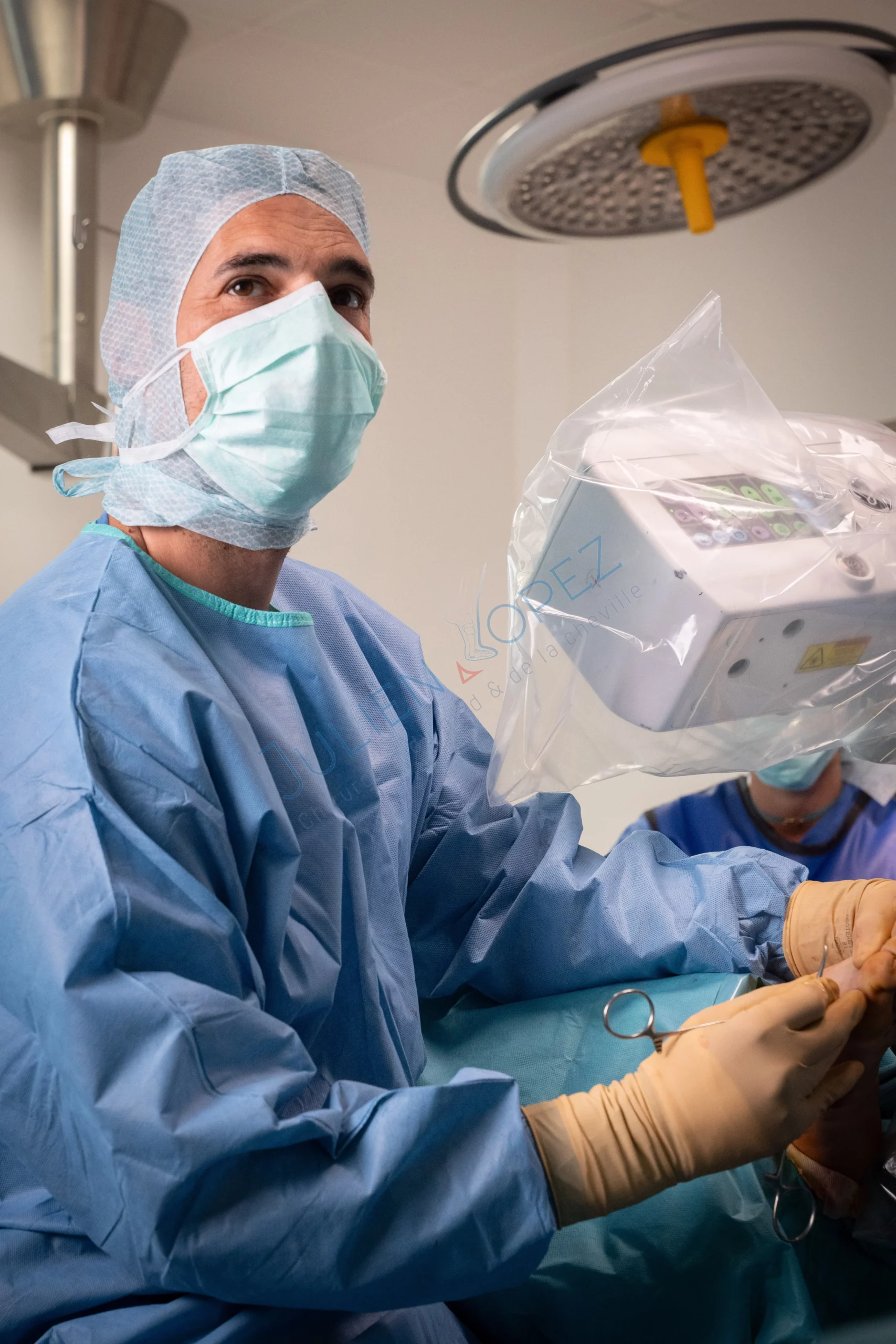
Claw toe surgery procedure: steps of the operation
The claw toe surgery procedure follows a precise protocol designed to be effective, safe and as straightforward as possible for the patient.
Anaesthesia and type of procedure
The operation is most commonly performed under regional anaesthesia, which numbs only the affected foot while ensuring full comfort during the procedure. General anaesthesia is rarely required.
In the majority of cases, claw toe correction surgery is carried out as a day case, allowing the patient to return home on the same day.
Minimally invasive surgery
Whenever possible, the surgeon at International Elite Care favours a minimally invasive approach to correcting claw toes, using percutaneous techniques. With the help of fine instruments and under radiographic guidance, the surgeon corrects the structures responsible for the deformity in order to realign the toe.
The aim of claw toe treatment surgery through minimally invasive techniques is to restore the natural position of the toe as far as possible, while preserving tissue. In the longer term, the toe should regain its function and stability.
At the end of the procedure, a special dressing is applied and an offloading shoe is prescribed to protect the forefoot as the patient begins walking again. The surgeon at International Elite Care then provides personalised instructions and arranges the post-operative follow-up. This follow-up is essential to support recovery and optimise the long-term outcome.
Claw toe surgery recovery and results
After surgery, claw toe surgery recovery is straightforward and well tolerated by the vast majority of patients, especially when the procedure has been performed using minimally invasive techniques. Recovery is supported by a structured follow-up programme designed to optimise the functional outcome.
Immediate post-operative care
Walking is permitted from the end of the operation, with an offloading shoe designed to protect the forefoot. This shoe is typically worn for approximately 3 to 5 weeks, until satisfactory healing has been achieved.
Post-operative pain is usually moderate and well managed with appropriate pain relief.
Regular post-operative appointments are arranged to monitor healing, assess how the correction is progressing and guide the gradual return to full weight-bearing. Dressings are adapted to the procedure performed, and instructions are adjusted at each follow-up consultation.
Returning to daily activities
During claw toe surgery recovery time, everyday activities can be resumed gradually. Driving is generally not recommended during the first few weeks, depending on which foot was operated on and the type of activity involved. Time off work may be necessary, with the duration varying according to the patient’s profession and the procedure performed.
Physiotherapy and rehabilitation following claw toe surgery are not always required. They may be recommended in certain cases to improve mobility and comfort. A return to sport is typically possible from around two months after surgery, provided there is no pain.
Expected results
After claw toe correction, results are assessed over the long term. The primary goal of surgery is to correct the deformity, provide lasting pain relief and improve comfort when walking and wearing shoes. Patients generally notice a gradual improvement in mobility and a marked reduction in the friction that previously caused skin lesions.
Our answers to your questions about claw toe surgery
Is claw toe surgery a major operation?
Percutaneous claw and hammer toe surgery is a targeted, minimally invasive procedure. For the patient, this means a lighter operation with a generally straightforward recovery. Progress is gradual and well supported when properly supervised.
Will I be able to walk soon after the procedure?
Yes, in the majority of cases. Walking is permitted from the end of the operation with a suitable offloading shoe. This early mobilisation helps maintain your day-to-day independence while protecting the foot during the healing phase.
Are the results of the operation long-lasting?
When the indication is well established and the correction is tailored to the type of claw toe, the results are most often long-lasting. The aim of surgery is to address the mechanical cause of the deformity, thereby reducing the risk of recurrence and providing lasting improvement in comfort when walking and wearing shoes. Following post-operative instructions plays an important part in ensuring a good long-term outcome.
How much does claw toe surgery cost?
The claw toe surgery cost depends on several factors, including the complexity of the deformity, the technique used, whether other associated abnormalities need to be corrected, and the facility where the procedure takes place.
At International Elite Care, a personalised estimate is provided in advance so that patients can make informed decisions with full transparency.
Can claw toe be corrected even if I am travelling from abroad?
Yes, International Elite Care was specifically designed to facilitate access to specialist care, particularly for international patients. The team coordinates consultations, the procedure and follow-up to minimise delays and provide a smooth, clear and reassuring care pathway, from initial contact through to your return home.
How to correct claw toe and how do I know if surgery is right for me?
Only a specialist assessment can answer this question with certainty. Understanding how to correct claw toe starts with a consultation that analyses your individual situation, your symptoms and your expectations, in order to guide you towards the most appropriate solution, whether non-surgical or surgical.
Surgeon performing the procedure


Full support
Take advantage of our all-in-one service: insurance, travel, post-operative follow-up, etc.
Ready to start your care journey?
From your country of residence, benefit from a teleconsultation with an expert surgeon and coordinated care in France or Andorra, with every detail of your medical stay carefully organised.