
Partial hip replacement
Discover personalised care for partial hip replacement. Get expert guidance and start your treatment journey today.
A partial hip replacement involves replacing the head of the femur with an implant, without replacing the socket of the pelvis.
Unlike a total hip replacement, which replaces the entire joint, a partial replacement mainly involves the femoral head rather than the acetabulum (the socket in the pelvis into which the femur fits).
The procedure of partial hip replacement in elderly patients is most often performed as an emergency. Its purpose is to restore mobility quickly, relieve pain and reduce complications associated with prolonged bed rest.
In most cases, a partial hip replacement provides effective functional recovery, allowing the patient to resume walking and improve their quality of life.
Indications for a Partial Hip Replacement Procedure
A partial hip replacement procedure is indicated when the femoral head is damaged, while the joint socket in the pelvis, known as the acetabulum, remains intact or is only mildly affected.
It is primarily recommended in cases of a fractured neck of the femur where there is a risk of non-union or avascular necrosis. This situation is most commonly seen in older people. A partial replacement is generally preferred when:
- the cartilage in the acetabulum is preserved
- there is no or only mild hip osteoarthritis
- the pelvic socket can continue to function properly without being replaced
This makes the procedure less extensive than a total hip replacement, offering a good balance between functional recovery and surgical safety.
A partial hip replacement is often selected for patients with moderate physical activity levels or comorbidities that make a shorter operation preferable, including:
- cardiovascular disease
- chronic respiratory conditions
- metabolic or systemic diseases, such as diabetes or kidney failure
- certain neurological or balance disorders
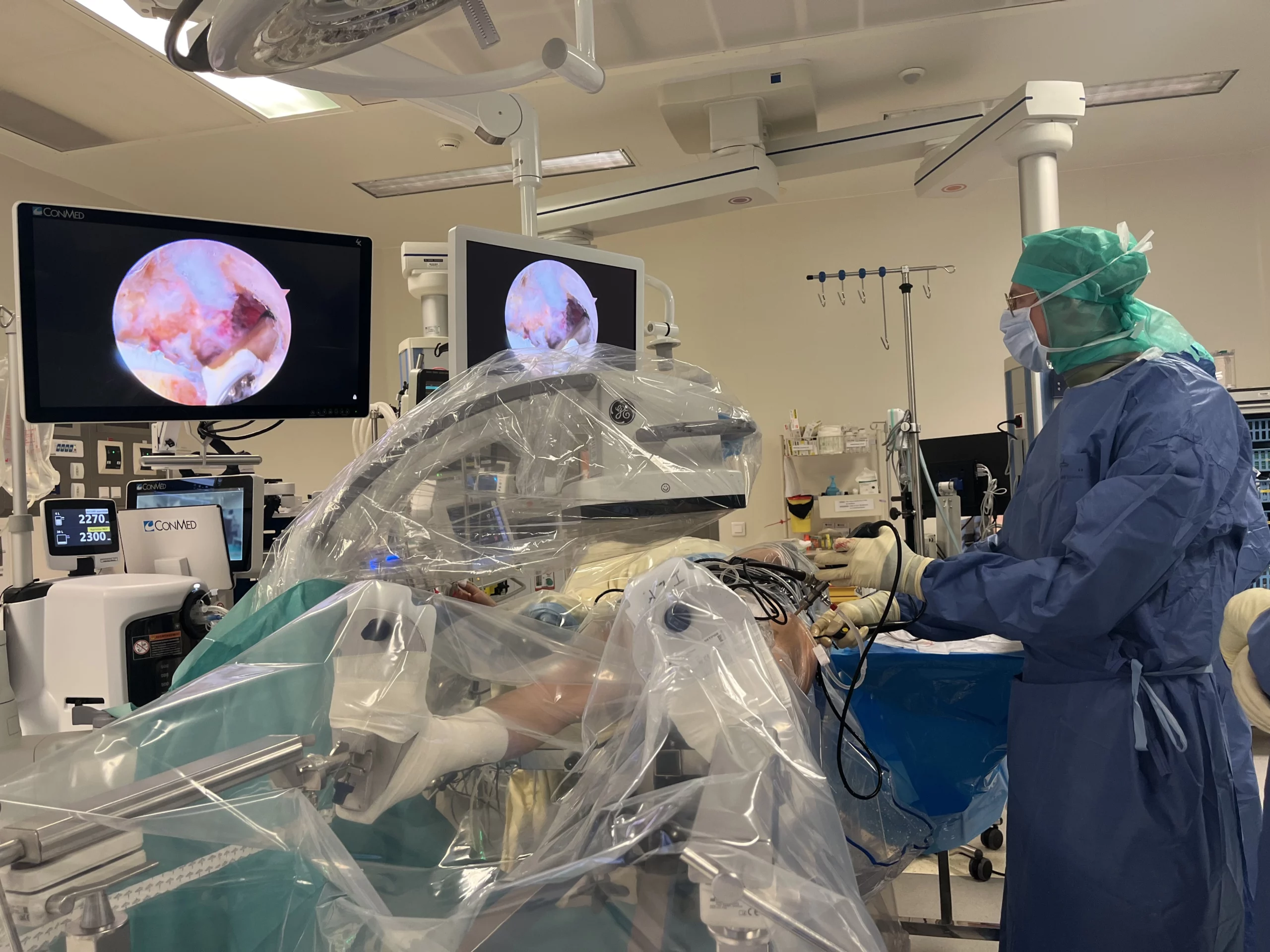
Partial Hip Replacement Surgery: Approach and Procedure
A partial hip replacement surgery is generally performed using an anterior approach (Hueter), from the front. The posterolateral (side approach) may be an alternative. It follows several well-established stages.
Before surgery, the patient has an anaesthetic consultation and a comprehensive medical assessment, including (blood tests, imaging and, where necessary, a cardiac assessment).
The procedure is performed under either general anaesthesia or spinal anaesthesia, which numbs the lower part of the body, depending on the patient’s individual profile. The femoral stem of the implant is most commonly made from titanium. This strong, durable and relatively lightweight material is compatible with bone and helps provide stable fixation.
Positioning and Surgical Procedure
The patient is positioned on the operating table according to the surgical technique being used. The specialist hip surgeon then makes an incision around the hip to perform the partial hip replacement. During the procedure:
- the fractured femoral head is removed
- a prosthetic stem is inserted into the femur
- an artificial femoral head is attached to the stem
The prosthesis may be cemented or uncemented, depending on bone quality. Cemented fixation is often preferred in older patients because it provides immediate stability. A monoblock bipolar partial hip replacement may also be used. With uncemented fixation, the bone is allowed to grow progressively around the implant.
Once the stability and mobility of the hip have been checked, the muscles and soft tissues are repositioned and the skin is closed with sutures or staples.
The operation generally takes between 45 minutes and one hour.
Return to the Ward and Monitoring
After surgery, the patient is taken to the recovery room and then to their hospital room. Post-operative care begins promptly, with pain management, prevention of complications and early mobilisation, often from the following day.
Partial Hip Replacement Recovery: Rehabilitation and Post-Operative Care
Following a partial hip replacement recovery is achieved by following a rehabilitation protocol. It is well established and closely supervised.
After surgery, pain gradually decreases over the following days. Painkillers are prescribed according to the patient’s needs.
Hospitalisation lasts an average of 2 to 5 days, depending on the patient’s age, general health and functional recovery after partial hip replacement. Where necessary, a transfer to a rehabilitation facility or arrangements for returning home can be organised.
Partial Hip Replacement Recovery timeline
Joint mobilisation begins quickly and forms an important part of partial hip replacement recovery timeline. It may start as early as the day after surgery with the support of a physiotherapist working with International Elite Care. Walking is initially resumed using a walking frame, followed by crutches, depending on the patient’s progress.
Weight-bearing on the operated leg is generally permitted early on, unless the surgeon advises otherwise.
Partial hip replacement rehab following a replacement helps restore hip mobility, strengthen the muscles and prevent stiffness and falls. It begins in hospital and continues in a rehabilitation facility or at home, depending on the patient’s general health and level of independence.
Prevention of Complications
Treatment is provided to help prevent:
- deep vein thrombosis (anticoagulants and compression stockings)
- infections
- complications associated with immobility, including (muscle loss, stiffness and unsteady walking)
Regular medical monitoring is provided throughout the post-operative period.
The patient can gradually resume independent walking and everyday activities.
Certain movement precautions may be recommended temporarily, particularly during the first few weeks.
Expected Results After a Partial Hip Replacement
In the vast majority of cases, partial hip replacement leads to satisfactory functional outcomes, with a rapid and lasting recovery:
- lasting pain relief
- restored mobility
- a return to independence
For many patients, walking becomes possible again with or without an assistive device, depending on their level of independence before surgery.
Results are generally better when treatment is provided promptly and rehabilitation is followed consistently.
A partial hip replacement is also designed to provide stability and durability over time. In some cases, particularly in younger or more active patients, a total hip replacement may be performed.
Our Answers to Your Questions About Partial Hip Replacement
What is a partial hip replacement?
A partial hip replacement is surgery that replaces only the damaged femoral head, the “ball” of the hip joint, while keeping the natural hip socket in place.
Will I be able to walk again quickly after surgery?
Yes. In most cases, walking can resume very soon after a partial hip replacement. The purpose of the procedure is specifically to enable the patient to stand and mobilise without waiting for a long and uncertain period of bone healing. Walking generally begins under medical and physiotherapy supervision, using appropriate walking aids, and progresses gradually according to the patient’s recovery and general health.
How long does a partial hip replacement take to heal?
Healing after a partial hip replacement usually takes around 6–12 weeks, although full recovery can take several months. Many patients begin walking with support within the first few days.
Is the procedure painful?
The pain caused by the fracture is generally significantly relieved after surgery. Some post-operative pain may occur during the first few days, but it is anticipated and managed with appropriate medication. The International Elite Care medical teams aim to maintain a high level of comfort throughout hospitalisation and recovery so that rehabilitation can take place under the best possible conditions.
Is a partial hip replacement better than full?
Neither is always better. A partial hip replacement may suit certain fractures when only the femoral head is damaged, while a total hip replacement is often preferred when both sides of the joint are affected or arthritis is present.
How long does it take to get back to a normal life?
It varies according to age, health and the level of independence before the fracture. Many patients quickly regain essential daily activities such as getting up, walking and moving around at home. The aim is a gradual return to as much independence as possible, supported by personalised rehabilitation throughout the recovery process.
What are the risks associated with the procedure?
As with any surgery, partial hip replacement carries risks, although these are generally well managed. Specific measures are implemented to prevent complications, particularly infections and circulatory complications. The surgeon systematically assesses the balance between benefits and risks in order to recommend the safest and most appropriate solution for each patient.
Is partial hip replacement major surgery?
Yes. A partial hip replacement is considered major surgery because it involves replacing part of the hip joint and requires anaesthesia, hospital care and a period of rehabilitation.
How do I know whether this procedure is suitable for me?
The decision to perform a partial hip replacement is based on a comprehensive medical assessment that takes into account the condition of the joint, the patient’s age, activity level and general health. Specialist advice is essential to confirm the indication and determine the most appropriate treatment pathway.
Can I receive support with my treatment arrangements and care journey?
Yes. Personalised support can help each patient find the most suitably qualified and available surgeon, arrange consultations promptly and facilitate their care pathway. This support simplifies the administrative process, reduces delays and provides reassurance at every stage.
When should I seek treatment for a hip fracture?
A hip fracture requires prompt medical care. The earlier treatment is provided, the better the chances of functional recovery and a return to independence. Seeking medical attention without delay helps ensure that the patient is quickly directed towards an appropriate treatment solution.
Surgeon performing the procedure


Full support
Take advantage of our all-in-one service: insurance, travel, post-operative follow-up, etc.
Ready to begin your journey?
Contact our team to explore your options and receive expert guidance tailored to your needs.