
Hip arthroscopy
Hip arthroscopy is a minimally invasive technique that enables conditions to be treated whilst preserving as much tissue as possible. This approach can support a smoother recovery after surgery, whereas more traditional surgery may result in more significant post-operative pain and a longer arthroscopy of the hip recovery period.
Performed under anaesthesia, hip arthroscopy is a hip procedure in which a small camera (arthroscope) and fine surgical instruments are inserted through tiny, millimetre-sized incisions. The camera transmits high-definition images, giving the surgeon a precise view inside the joint.
The hip arthroscopy operation enables targeted and precise treatment while preserving the tissues as much as possible. The objectives are to relieve pain, improve mobility and support a faster return to everyday activities.
The surgeons at International Elite Care are recognised specialists in minimally invasive hip surgery, with extensive experience and a high volume of arthroscopic procedures. Their approach is based on a precise assessment of each patient’s situation, the use of established surgical techniques and rigorous care at every stage of the treatment journey. The aim is to provide reliable, personalised treatment in line with the highest medical standards.
When is hip arthroscopy indicated?
Hip arthroscopy is a minimally invasive technique particularly suited to active, relatively young patients without advanced osteoarthritis. As the aim is to preserve the joint, the hip must be sufficiently healthy for the procedure to provide good results. The main indications include:
- Femoroacetabular impingement (FAI)
- Labral tear
- Articular cartilage lesions
- Unexplained mechanical pain documented by imaging
- Certain specific conditions, including loose bodies, synovitis and post-traumatic changes
Every indication is assessed thoroughly during a consultation with the surgeon. At International Elite Care, this consultation can be carried out remotely, helping to simplify the treatment journey for international patients.
When is surgery not indicated?
Hip arthroscopy is generally not recommended in cases of advanced osteoarthritis, when the cartilage has been extensively damaged. In these situations, other treatment options may be more appropriate, appropriate (medical treatment, hip replacement).
Surgery is never the first-line option. For example, hip labral arthroscopy is generally considered as a second step, following a thorough assessment of the underlying factors and the implementation of appropriate conservative treatment.
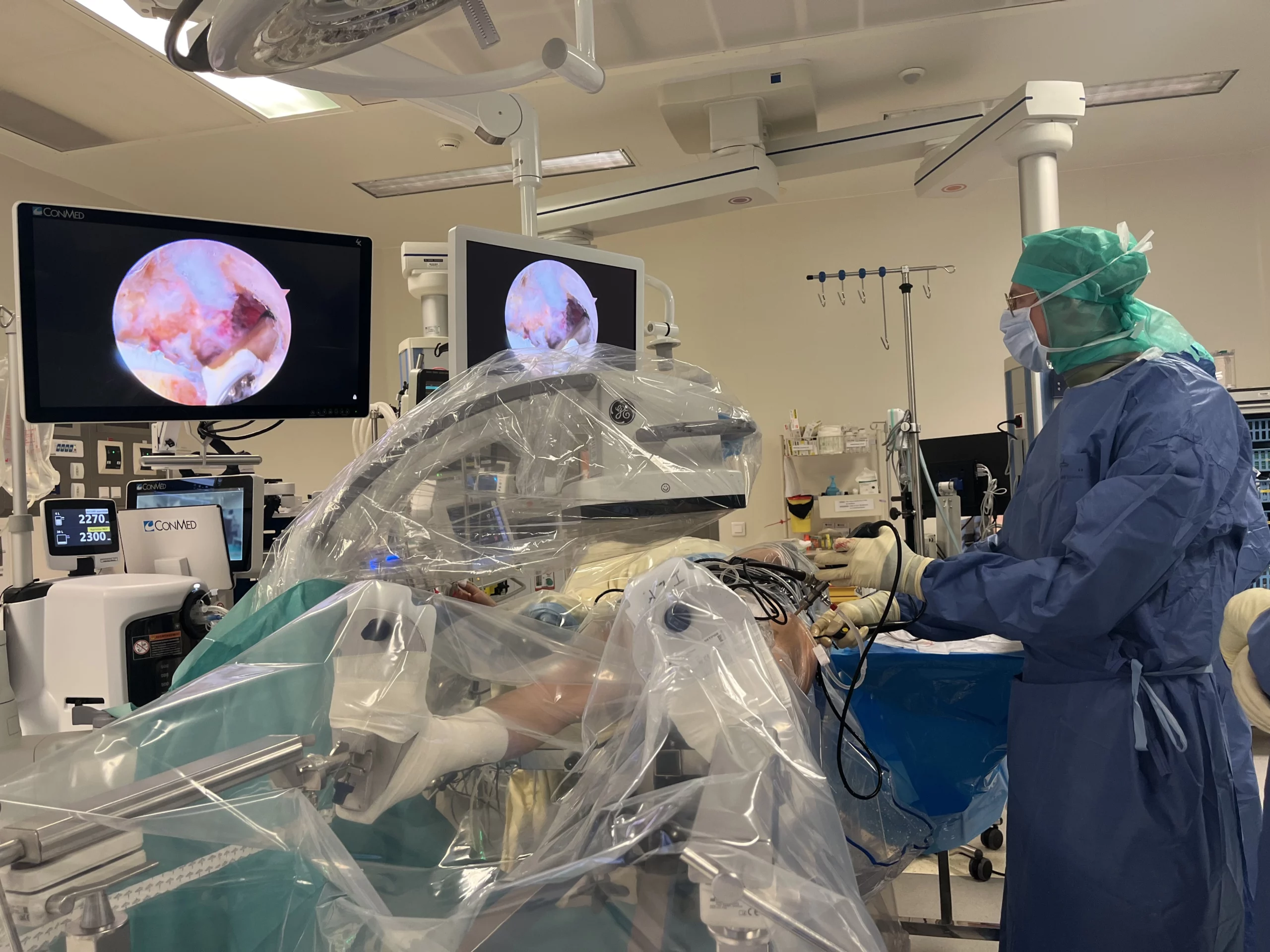
Hip arthroscopy surgeons: a procedure performed by expert specialists
Hip arthroscopy is performed in a specialised surgical environment and follows precise protocols designed to ensure patient safety and comfort. Here is how the hip arthroscopy procedure is carried out, step by step.
Before surgery, a comprehensive assessment is carried out by a surgeon specialising in hip treatment : this includes a clinical examination, specialist imaging (MRI, arthro-MRI, arthro-CT) and detailed discussions with the patient.
On the day of surgery, the procedure is performed under general anaesthesia. This may sometimes be combined with regional anaesthesia to optimise post-operative comfort.
The patient is positioned on a specialised operating table that allows the hip to be positioned precisely.
Small, millimetre-sized incisions are made around the joint before a small camera is inserted into the hip, providing a detailed, high-definition view of the joint. Using fine surgical instruments, the surgeon treats the identified lesions, which may include:
- labral repair or trimming,
- correction of a bony impingement,
- targeted treatment of cartilage,
- removal of fragments or pathological tissue.
All procedures are performed in a precise and targeted manner, while preserving the anatomical structures as much as possible.
The duration varies depending on the complexity of the lesions being treated. It generally ranges from 60 minutes to 2 hours.
After surgery, the patient spends some time in the recovery room under the supervision of the medical team. In most cases, hip arthroscopy requires only a short hospital stay, sometimes as a day-case procedure or with one overnight stay, depending on the medical circumstances and the organisation of the patient’s stay.
Hip arthroscopy recovery and post-operative care
After hip arthroscopy, recovery is generally straightforward to manage. The minimally invasive nature of the procedure can provide greater post-operative comfort. In addition, patients receive high-quality, personalised follow-up, which is essential for optimising recovery.
Some discomfort or moderate pain may occur during the first few days of recovery after hip arthroscopy. This is usually well controlled with appropriate pain relief prescribed at discharge. Local swelling or temporary stiffness may also occur.
Weight-bearing can often resume quickly. It may initially be partial, using crutches. Walking is progressively authorised under medical supervision, while hip movements are controlled to protect the repairs performed during surgery.
Following arthroscopy for hip bursitis, recovery is often shorter because the procedure is less invasive within the joint. By contrast, arthroscopy for hip impingement generally involves a longer recovery, as it requires more extensive procedures than a straightforward arthroscopy.
Potential complications after arthroscopy of the hip
As with any surgical procedure, complications can occur after arthroscopy of the hip, although they are uncommon and are anticipated from the outset of the patient’s care. When complications do occur, they are most often temporary. They may include:
- local infection,
- haematoma or bleeding,
- deep vein thrombosis (blood clot) or thromboembolic complications,
- temporary hip stiffness,
- slower-than-expected recovery,
- temporary irritation of nerves close to the joint.
To help minimise these risks, the surgeons at International Elite Care carry out a thorough pre-operative assessment and provide structured follow-up after surgery. This helps to secure the patient’s treatment journey at every stage.
Hip arthroscopy rehab and long-term outcomes
Rehab after hip arthroscopy is an essential part of recovery. It begins soon after surgery to restore mobility, strengthen the muscles and improve hip stability.
At International Elite Care, a personalised programme is established according to the lesions treated and the patient’s individual profile. If rehabilitation needs to continue after the patient returns to their home country, follow-up can be provided remotely, with rehabilitation instructions shared and coordination with local physiotherapists where necessary.
With rehabilitation, everyday activities can gradually be resumed during the weeks following surgery. If required, a fit note for time off work following hip arthroscopy can be provided.
Driving is permitted once medically approved, while a return to sport is supervised and often takes place between 3 and 6 months, depending on the activity and the complexity of the procedure.
Follow-up consultations are used to:
- check healing,
- adjust the rehabilitation programme,
- assess functional progress,
- support lasting results.
Expected results after recovery
The results of hip arthroscopy rehab protocol are generally satisfactory when the indication is appropriate and the treatment protocol is followed.
In most cases, hip arthroscopy relieves mechanical hip pain, particularly during walking and hip flexion or rotation. Improvement is progressive and develops over the weeks following surgery alongside rehabilitation.
Patients may also experience an improved range of hip movement. Feelings of catching or instability may decrease, making everyday movements smoother and less restrictive.
For active patients, hip arthroscopy can support a return to sport and physical activities according to an individualised timeline. The timeframe depends on the sport, its intensity and the procedures performed during surgery.
Outcomes vary according to the patient’s individual profile, including:
- age,
- activity level,
- condition of the cartilage at the time of surgery,
- adherence to the rehabilitation programme.
Our answers to your questions about hip arthroscopy
How much does a hip arthroscopy cost?
The cost of a hip arthroscopy varies depending on the procedure, the complexity of the condition, the surgeon’s fees and any additional care required. For patients considering private treatment, the hip arthroscopy private cost may also depend on the clinic, anaesthesia, diagnostic tests and follow-up appointments. Contact our team to discuss your situation and receive a personalised quote.
Am I a good candidate for hip arthroscopy?
Only a specialist assessment can confirm whether hip arthroscopy is appropriate. The procedure is intended for patients with persistent mechanical hip pain, abnormalities identified on imaging and no osteoarthritis.
Is a teleconsultation sufficient before travelling for treatment?
In many cases, yes. A pre-operative teleconsultation allows the medical team to review your medical records and imaging and discuss your symptoms in detail. It is an essential first step in establishing the indication, answering your questions and organising your visit efficiently. An in-person consultation is then scheduled when you arrive, before surgery.
Is hip arthroscopy a painful procedure?
Pain after hip arthroscopy is generally moderate and temporary. It is anticipated in advance and managed with appropriate pain relief. Most patients report progressive improvement, with a significant reduction in their initial symptoms as recovery progresses.
How long do I need to stay after surgery?
The length of your stay depends on your medical situation and the arrangements made for your treatment. After hip arthroscopy, rehabilitation begins promptly under post-operative supervision, and various checks are carried out. Depending on the circumstances, this may require several days. This is why the International Elite Care team supports you with the overall organisation of your stay, including accommodation and travel arrangements where necessary.
How long does a hip arthroscopy take?
A hip arthroscopy usually takes around 1 to 2 hours, although the exact duration depends on the condition being treated and the complexity of the procedure.
Can I travel after hip arthroscopy?
Yes, returning to your home country is generally possible within a timeframe compatible with a short medical stay. The arrangements will be confirmed by your surgeon based on your recovery. You will receive clear recommendations to help you travel safely.
What happens with my follow-up once I return home?
Medical follow-up continues after you return to your home country. A personalised protocol is established, with regular remote consultations where necessary. Rehabilitation instructions, warning signs and the stages for resuming activities are clearly explained to ensure continuity of care, in coordination with local healthcare professionals where appropriate.
Are the results long-lasting?
When the indication is appropriate and the hip arthroscopy recovery timeline is followed correctly, the benefits of hip arthroscopy can be long-lasting. The procedure aims to correct the mechanical causes responsible for symptoms, supporting improved function and quality of life in the medium and long term. In addition, hip arthroscopy leaves only small, discreet scars.
Can someone accompany me during my medical stay?
Yes, you are welcome to travel with a companion. Support is an integral part of the experience provided by International Elite Care. This includes solutions adapted to your accommodation, travel arrangements and the overall organisation of your stay.
How do I choose the right surgeon for my procedure?
International Elite Care will refer you to a surgeon with expertise in your specific condition, recognised for their experience and high level of specialisation. This referral considers your medical indication, availability and the location of your treatment.
How do I book an appointment and start my treatment journey?
Getting in touch is simple and quick. You simply need to contact the International Elite Care team to arrange an initial consultation, often remotely. You are then supported at every stage, from the initial assessment through to follow-up after you return home.
Surgeon performing the procedure


Full support
Take advantage of our all-in-one service: insurance, travel, post-operative follow-up, etc.
Ready to begin your journey?
Contact our team to explore your options and receive expert guidance tailored to your needs.