
Loose hip implant: diagnosis and treatment
A loose hip implant can cause pain and reduced mobility. International Elite Care supports you throughout your care with expert, secure and personalised treatment.
Hip implant loosening occurs when the connection between the implant and the bone loses grip because the fixation is no longer sufficient. This can happen some time after the initial surgery, sometimes gradually and without obvious symptoms at first.
It is one of the most common reasons for revision surgery following total hip replacement. When loosening occurs, it can cause pain and significantly restrict mobility.
How is a loose hip implant diagnosed?
Diagnosing hip implant loosening requires a thorough assessment combining a clinical examination with imaging tests. The aim is to identify the precise cause of the pain, confirm whether the implant has become loose and determine why, so that the most appropriate treatment can be recommended.
The assessment begins with a detailed consultation with an orthopaedic surgeon specialising in hip conditions. This involves analysing the onset and progression of pain (whether gradual or sudden), its location (groin, buttock, thigh) and any difficulties with walking or putting weight on the leg.
Previous surgery and the time elapsed since the hip replacement were performed are also reviewed. The surgeon will assess hip mobility and joint stability and check whether certain movements reproduce the pain.
Hip X-rays are then used to complement the clinical assessment. They can show any displacement of the implant, loss of fixation between the bone and implant, and signs of wear around the joint.
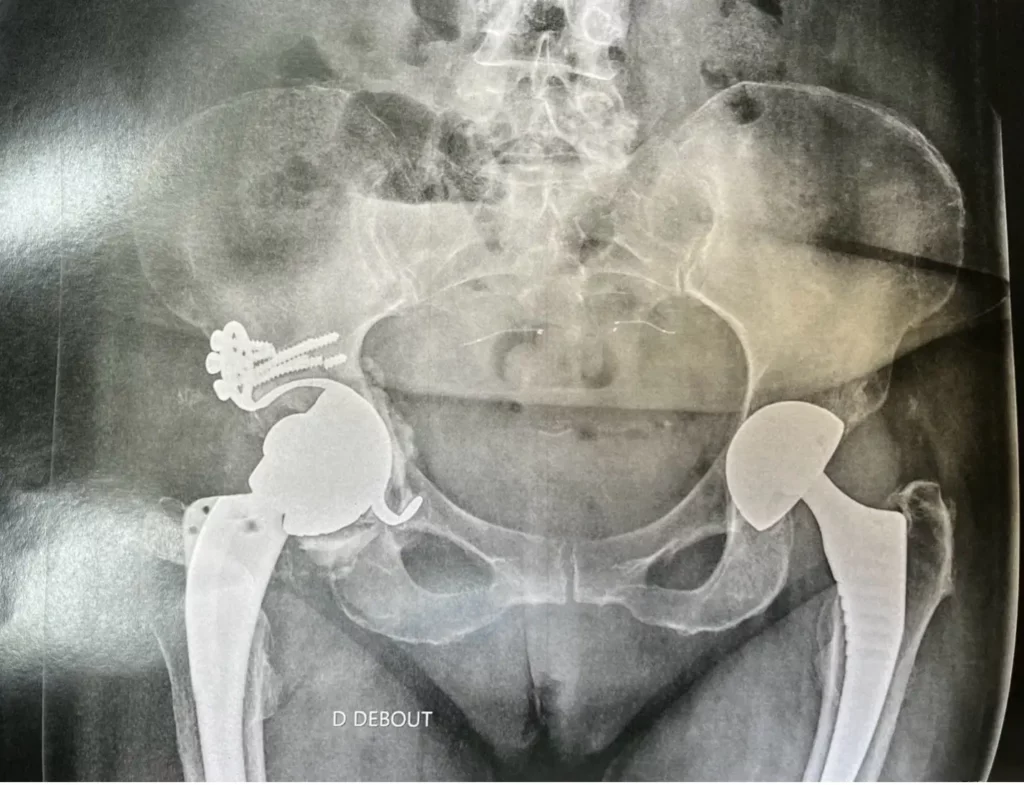
When X-rays are inconclusive or further detail is required, additional investigations may be recommended:
- CT scan: provides a detailed assessment of the bone–implant interface and bone quality
- MRI adapted for hip implants: assesses the soft tissues and inflammation around the joint
- Bone scan: detects abnormal activity around the implant
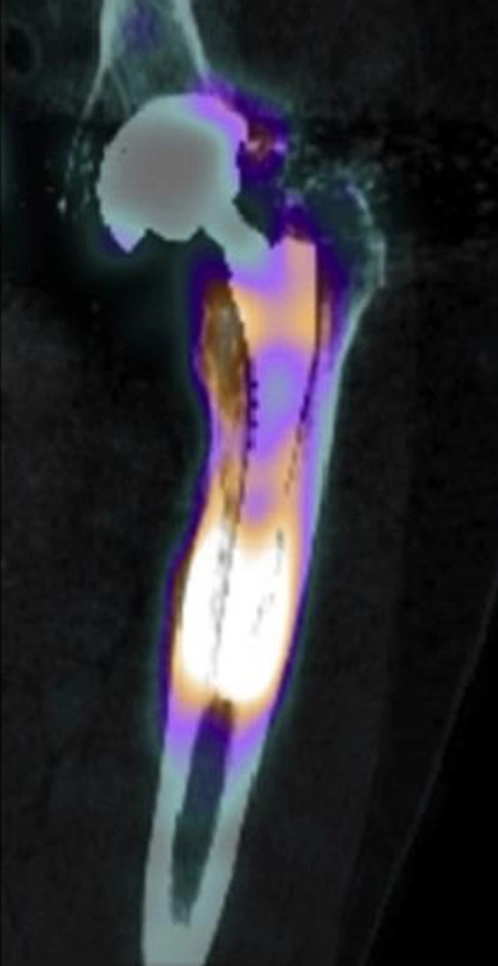
A blood test is also performed to look for signs of inflammation or infection. This is an essential part of diagnosing hip implant loosening, as it helps distinguish between the different types of loosening.
Hip implant loosening can have a mechanical, biological or infectious cause:
- Mechanical: caused by the natural wear of materials or repeated stresses placed on the joint.
- Biological: caused by the bone reacting to microscopic wear particles, leading to bone resorption.
- Infectious: caused by bacteria being present around the implant.
All clinical, biological and radiological findings are assessed by a surgeon specialising in hip surgery, who develops a personalised care pathway.
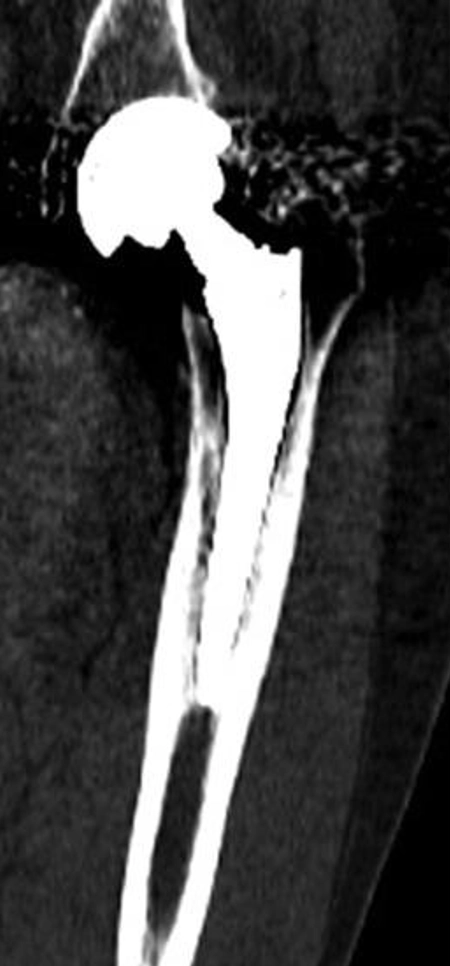
Loose hip implant symptoms and clinical signs
Symptoms of hip implant loosening are often progressive and may appear several years after the original surgery. Because they can develop slowly, specialist assessment is recommended as soon as unusual symptoms appear.
Pain is the most common symptom of hip implant loosening. It may be felt in the groin or buttock or radiate into the thigh. It usually occurs when walking, bearing weight or standing up. In more advanced cases, pain may also occur at night or at rest.
Other symptoms of a loose artificial hip joint include:
- Reduced range of movement in the hip
- Difficulty performing certain activities, such as (walking for long periods, climbing stairs or getting up from a chair)
- A feeling that the hip is less reliable or unstable
- Possible limping caused by pain or instability
- Unusual noises or sensations, such as (clicking or cracking), particularly during activity
In more advanced cases, loosening can significantly reduce independence and restrict everyday activities, including work, sport and leisure.
Treatment for hip implant loosening by specialist surgeons
International Elite Care specialists offer personalised treatment for hip implant loosening.
Treatment depends on several factors, including the severity of the symptoms, the extent of the loosening, the identified cause (mechanical, biological or infectious), the condition of the bone and the patient’s overall health and profile.
In some situations, non-surgical treatment may be sufficient. However, in most cases, surgery is required.
Non-surgical treatment for a loose hip implant
If the condition is diagnosed early and symptoms are mild, medical monitoring may be recommended.
In this situation, physical activities are adapted, the joint is monitored regularly through clinical and imaging assessments, and pain relief and anti-inflammatory medication may be prescribed when required.
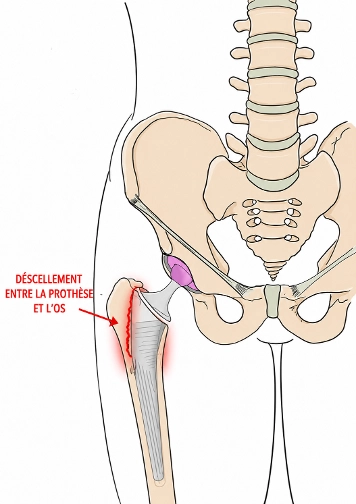
These measures are temporary and cannot correct confirmed implant loosening. However, they may delay surgery when symptoms remain moderate.
Surgical treatment for aseptic hip implant loosening
If there is no confirmed infection, the loosening is considered aseptic.
If only one component of the hip replacement is affected, such as the (acetabular cup or femoral stem), the damaged component is replaced while stable components are retained.
If several components have become loose or there is significant bone loss, complete revision hip replacement is required. The existing implant is removed and replaced with a new implant adapted to the patient’s condition.
Bone reconstruction techniques may also be required if the bone needs to be strengthened to provide adequate support for the new implant.
Special case: infectious loosening of a hip implant
When hip implant loosening is caused by infection, treatment differs from that used for mechanical or biological loosening. The aim is not only to stabilise the implant but also to completely eliminate the infection.
The medical team therefore carries out a thorough assessment to confirm the presence of bacteria and identify the organism responsible. Treatment is then adapted accordingly:
- One-stage surgery (the most commonly used): the existing implant is removed, the affected area is cleaned and the new implant is inserted during the same operation.
- Two-stage surgery : the prothesis is removed, the tissues are cleaned, and a temporary antibiotic-loaded spacer is inserted, followed by a course of targeted antibiotic treatment. Once the infection has been eliminated, the definitive new implant is inserted.
Surgical treatment is always combined with antibiotic therapy prescribed according to the bacteria identified.
Our answers to your questions about a loose hip replacement
Find out more about the management of a loose hip replacement with the International Elite Care experts.
Is a loose hip implant an emergency?
Hip implant loosening is not usually an emergency, but it does require prompt specialist assessment. Early diagnosis enables the best possible treatment options to be offered and helps prevent the pain from worsening and further bone loss.
What does a loose hip implant feel like?
A loose hip implant may feel like increasing pain in the groin, thigh or buttock, instability, clicking, or discomfort when walking or bearing weight, and should be assessed by an orthopaedic specialist.
Will I definitely need another operation?
Not necessarily. If a loose hip replacement causes few or no symptoms, medical monitoring may sometimes be considered. However, if pain is present or the stability of the implant is compromised, revision surgery is the standard treatment to restore a functional hip.
Is revision surgery more complex than a first hip replacement?
Yes. Revision surgery for a loose hip replacement is more technically demanding than an initial hip replacement. It should therefore be performed by a surgeon who specialises in hip surgery and is experienced in this type of procedure. International Elite Care works with specialist surgeons in this field to support reliable and lasting outcomes.
How long does recovery take after revision hip replacement?
In most cases, walking is resumed within the first few days after surgery with assistance, and rehabilitation begins promptly. Between 3 and 6 weeks, walking generally becomes more independent and everyday activities are gradually resumed.
Between 6 and 12 weeks, most patients are able to walk without assistance and regain satisfactory mobility. After 3 to 6 months, low-impact physical activities such as longer walks, cycling or swimming can generally be considered, depending on the surgeon’s advice.
In some cases, depending on the type of surgery performed, weight-bearing may not be permitted until 6 weeks after the operation.
Can I arrange my treatment from abroad?
Yes. International Elite Care supports international patients at every stage of their care, from the pre-operative video consultation through to post-operative follow-up.
The team coordinates the medical stay, care arrangements and support before, during and after hospitalisation, helping to provide a smooth, secure and personalised care pathway.
Can I come with a companion?
Absolutely. A companion can stay with you throughout your medical journey, with suitable accommodation and practical arrangements available.
Surgeon performing the procedure


Full support
Take advantage of our all-in-one service: insurance, travel, post-operative follow-up, etc.
Ready to begin your care journey?