
Bunionette Operation: Expert Treatment by Specialist Surgeons
Bunionette operation treats the painful deformity at the base of the little toe, restoring foot alignment and improving daily comfort.
This deformity presents as a painful bony prominence, often combined with a progressive inward deviation of the little toe, causing friction and inflammation. The condition is also known as quintus varus or tailor’s bunion.
Bunionette correction demands a precise, perfectly balanced surgical approach to preserve the harmony of the forefoot. This is why it is advisable to seek out expert surgeons who can deliver high-quality care.
The International Elite Care surgeons specialise in foot surgery and have extensive experience in forefoot procedures. This expertise allows them to adapt the technique to each patient’s morphology and to ensure a stable, lasting correction.
Procedures are carried out in France or Andorra, within facilities meeting the highest medical standards. Beyond the surgical technique itself, every patient benefits from a personalised analysis, rigorous planning and structured follow-up, which can be conducted remotely for the convenience of international patients.
Bunionette Treatment: When Is Surgery Indicated?
Bunionette treatment usually begins with conservative measures, but surgery may be recommended when pain persists and daily activities become difficult.
The main indications for a bunionette deformity correction surgery are:
- Persistent pain on the outer border of the foot,
- Failure of conservative treatment (orthoses, anti-inflammatory medication, etc.),
- Progressive and visible deformity of the little toe,
- Repeated inflammation (redness, swelling, bursitis),
- Aesthetic impact combined with functional impairment.
All these situations share a common feature: they involve meaningful pain or functional difficulty that affects the patient’s daily life. These symptoms are essential, because bunionettes treatment by surgery is not indicated for a painless deformity alone. It is reserved for patients whose quality of life is genuinely impaired despite non-surgical management.
The expert foot doctor at International Elite Care offer a pre-operative assessment, which can be carried out remotely to simplify access and start the care pathway promptly. This initial exchange confirms the indication, reviews X-rays, proposes the most suitable technique and directs you to the most qualified and available expert surgeon.
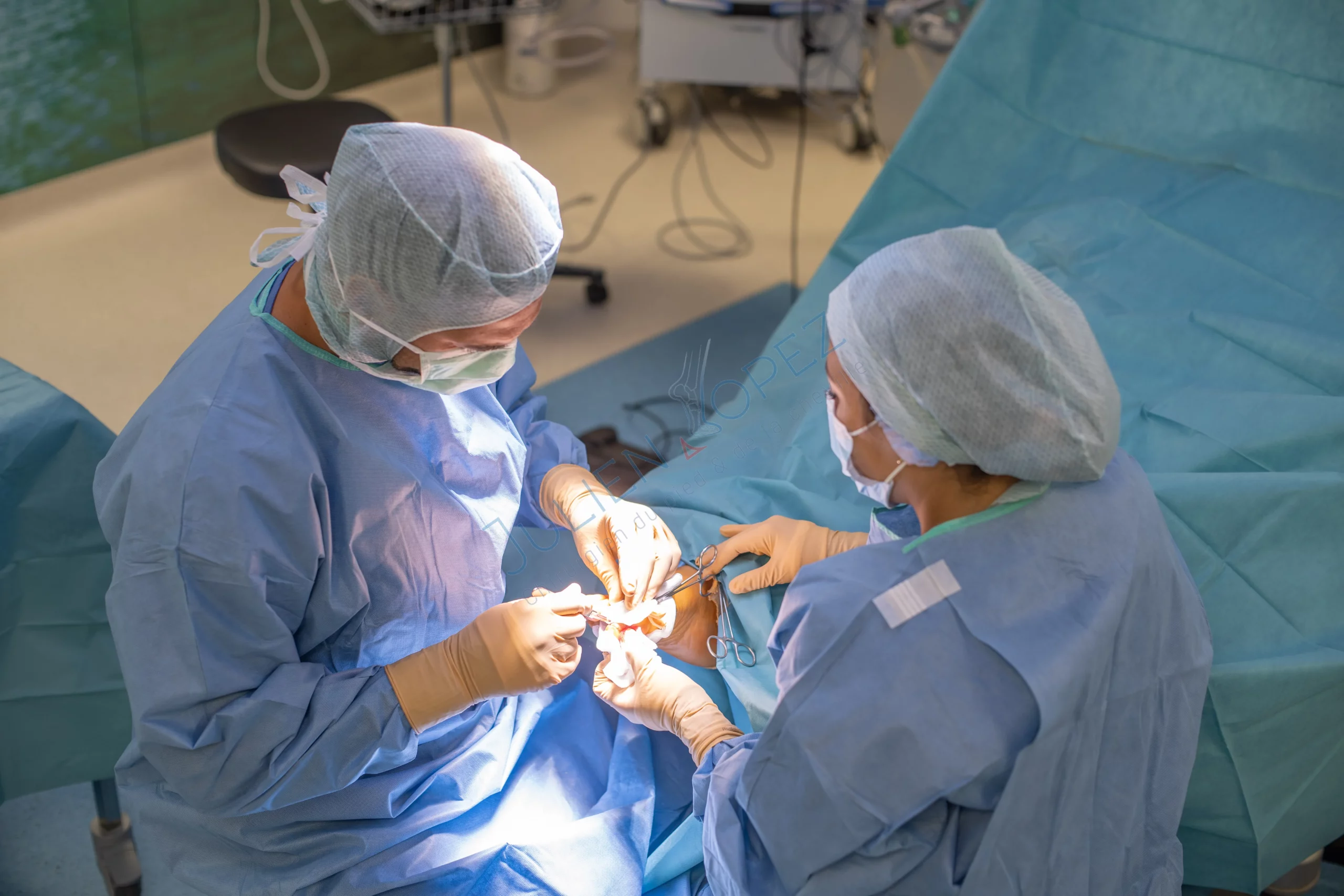
Operation of a Bunionette: How the Procedure Works
At International Elite Care, operation of a bunionette is a procedure that is personalised according to the patient’s anatomy and the extent of the deformity.
The pathway begins with a specialist consultation, analysis of foot X-rays and precise planning of the surgical steps. A standard pre-operative workup ensures optimal safety.
The procedure takes place in a specialist facility, offering comfort and safety to the highest standards. Anaesthesia is most commonly regional (foot or ankle only), sometimes combined with light sedation.
Operating time is approximately 30 to 60 minutes, depending on the technique used. Depending on the type of bunionette, the surgeon may perform:
- Excision of the bony prominence (exostosis),
- Osteotomy of the fifth metatarsal (bone cut and realignment),
- Pin stabilisation to maintain the correction (pin removed after 3 to 5 weeks).
In every case, the incision is discreet, located on the outer border of the foot. Thanks to modern techniques and the expertise of the International Elite Care surgeons, the procedure delivers precise correction, immediate stability and a more comfortable recovery.
Walking is permitted quickly, provided a specific post-operative shoe is worn. In most cases, the procedure is performed on a day-case basis, with discharge the same day or the following morning. A follow-up protocol is established, which can be organised remotely if needed.
Bunionette Surgery Recovery: Post-Operative Course and Results
After bunionette surgery, the recovery usually progresses gradually over several weeks, allowing the foot to heal properly and comfort in daily activities to return.
Bunionette Surgery Recovery Week by Week
- Days 1–7: Post-operative shoe worn for walking; moderate swelling and mild pain managed with prescribed medication; rest with foot elevated.
- Week 2: Sutures removed (even dissolvable ones are checked); wound care continues.
- Weeks 3–5: Post-operative shoe still worn; swelling begins to subside; light daily activities gradually resume.
- Weeks 5–6: Transition to wide, comfortable standard footwear; driving may resume once weight-bearing is comfortable and secure.
- Weeks 6–8: Prolonged walking resumes progressively; gentle sport (flat walking, swimming, cycling) may be considered.
- Month 3 onwards: Higher-impact sport (running, tennis, football) can restart, subject to the surgeon’s approval.
- Months 3–6: Definitive result appreciated as swelling fully resolves and the foot regains its final shape.
Bunionette Surgery Success Rate and Expected Outcomes
The long-term outcomes are typically very satisfying. When considering bunionette surgery, patients can expect:
- Lasting pain relief,
- Improved comfort when wearing shoes,
- A more harmonious forefoot appearance,
- Durable correction of the deformity.
These results are generally appreciated between 3 and 6 months after the surgery, once swelling has fully resolved.
As with any surgery, complications remain possible (infection, delayed healing, stiffness), but they are uncommon when the procedure is performed by an experienced surgeon.
Bunionette Deformity Treatment: Conservative Options Before Surgery
Bunionette deformity treatment begins with conservative measures aimed at relieving symptoms and slowing progression:
- Orthotic insoles to redistribute pressure,
- Appropriate footwear (wide toe box, soft materials),
- Orthoplasty (custom silicone toe separator),
- Anti-inflammatory medication or cortisone injections for acute flares.
Not every bunionette requires an operation. These measures can provide significant relief but do not correct the underlying bony deformity. When symptoms persist or worsen, bunionette deformity correction through surgery becomes the definitive solution.
Your Bunionette Surgery Questions Answered
The International Elite Care team answers all your questions regarding bunionette surgery.
Do bunionettes get worse over time?
Yes, bunionettes (also called tailor’s bunions) typically worsen over time if untreated. They start as a small bony bump on the outside of the foot at the base of the pinky toe but progressively enlarge, causing more pain, swelling, and misalignment.
How to correct a bunionette?
The way to correct a bunionette depends on its severity. Mild cases may respond to conservative measures (insoles, footwear adaptation, orthoplasty). When the deformity is painful or progressive, percutaneous or minimally invasive surgery offers a precise, lasting correction with a comfortable recovery.
Is bunionette surgery worth it?
Bunionette surgery is often a game-changer for patients dealing with ongoing foot pain that limits daily activities like walking or wearing shoes.
Is bunionette surgery painful?
Bunionette surgery pain is generally moderate and well controlled with tailored medication and effective regional anaesthesia. Most patients describe the discomfort as transient, related more to swelling than to intense pain. The International Elite Care team remains available to adjust treatment if needed, ensuring optimal comfort during the first days.
What is the recovery time for bunionette surgery?
The recovery time for bunionette surgery varies by individual and technique. Walking resumes within days in a post-operative shoe. Standard footwear is typically possible after 5–6 weeks, and the definitive result is appreciated at 3–6 months.
How long must I stay if I am coming from abroad?
For international patients, a stay of approximately 1 to 3 days is usually sufficient. This allows time for the surgery, the first post-operative check and the organisation of a safe return. International Elite Care coordinates the entire schedule in advance, with the option of remote follow-up once you are home.
Is the result permanent?
The bony correction achieved during surgery is designed to be stable and lasting. When the indication is well established and post-operative instructions are followed, recurrence is rare. The final result is appreciated progressively once swelling has fully resolved, a more harmonious, comfortable and durably relieved foot.
How can I be sure I am consulting the right specialist?
International Elite Care brings together expert, high-volume foot surgeons practising in France and Andorra. Every case is carefully reviewed to direct you to the most qualified practitioner for your specific situation, taking into account your timing and logistical constraints. A pre-operative video consultation allows your case to be assessed precisely before any decision, in complete transparency and with no obligation.
Surgeon performing the procedure


Full support
Take advantage of our all-in-one service: insurance, travel, post-operative follow-up, etc.
Ready to start your care pathway?
From your country of residence, benefit from a teleconsultation with an expert surgeon and coordinated care in France or Andorra, with every detail of your medical stay carefully organised.