
Foot operations for arthritis
Foot operations for arthritis are surgical procedures designed to relieve joint pain caused by cartilage deterioration. The goal is to restore a satisfactory level of walking comfort and to improve the patient’s overall quality of life.
This surgery is tailored to the specific joint affected (forefoot, top of the foot, hindfoot, ankle or big toe), the stage of arthritis, and the patient’s profile and functional expectations.
Depending on the situation, the procedure may aim to preserve some joint mobility or, alternatively, to permanently eliminate the painful movement responsible for the symptoms.
Foot surgery for arthritis may be used to:
- correct a bony impingement,
- realign certain structures,
- partially replace the joint,
- fuse the bone surfaces together (when arthritis is advanced).
At International Elite Care, foot operations for arthritis on the right or left foot are carried out by surgeons who specialise in foot and ankle conditions.
A thorough assessment carried out beforehand defines the most appropriate surgical strategy, with a focus on safety, effectiveness and optimal recovery. International Elite Care supports patients at every stage, ensuring a smooth, personalised and reassuring care pathway.
Foot surgery for arthritis on top of foot: indications for surgical treatment
Foot surgery for arthritis on top of foot is recommended when the condition becomes debilitating and non-surgical treatments no longer provide lasting relief. The decision to operate always takes into account the level of functional impairment, the progression of the arthritis and the patient’s expectations.
Surgery may be considered in the following situations:
- Persistent or worsening pain
- Failure of conservative treatment (appropriate footwear, orthotics, injections)
- Significant difficulty walking or wearing shoes, affecting daily activities
- Pronounced joint stiffness with progressive loss of function
- Associated deformities of the foot or toes causing further problems
- Marked deterioration in quality of life, with reduced independence
Following a full clinical and radiological assessment, the feet specialist determines whether surgical management is appropriate and, if so, which technique will offer the best balance between pain relief, functional recovery and long-lasting results.
At International Elite Care, this decision is explained in a clear and straightforward manner, so that the patient can embark on their care pathway with full confidence.
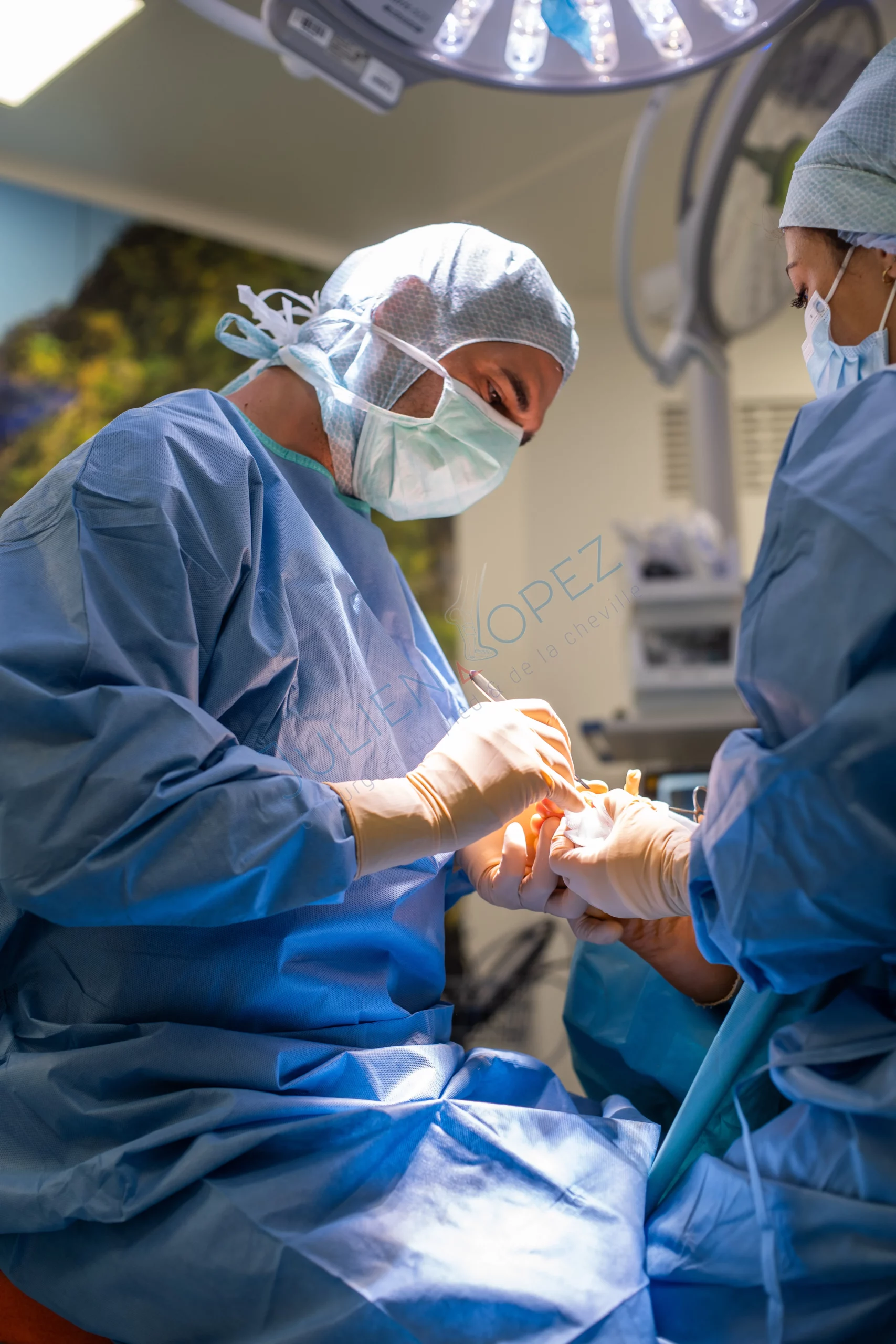
Operation on foot for arthritis: how the procedure works
An operation on foot for arthritis follows a precise and carefully controlled protocol.
Before the operation, a comprehensive preoperative assessment is carried out. This includes a clinical examination, imaging studies and an anaesthetic consultation. This step confirms the indication for surgery and helps select the most suitable technique, while also preparing for the postoperative period and recovery.
Anaesthesia
The procedure is performed under general anaesthesia or regional anaesthesia (numbing the leg and foot). In some cases, a spinal anaesthetic is used (numbing both legs).
The procedure
The principle of the operation is to address the mechanical source of pain caused by arthritis. Depending on the case, the surgeon may:
- remove areas of damaged cartilage and troublesome bony outgrowths,
- realign certain bony structures,
- preserve or partially restore joint mobility,
- permanently fuse the joint (foot arthrodesis).
Whenever possible, minimally invasive or percutaneous techniques are favoured. These reduce incision size, limit postoperative discomfort and promote a faster recovery. The surgeons at International Elite Care are experts in these techniques, enabling them to operate under optimal conditions.
Duration of the procedure
On average, the operation takes between 45 minutes and 1 hour 30 minutes, depending on the surgical technique used and the complexity of the case.
Foot fusion surgery for arthritis: recovery and expected results
After foot fusion surgery for arthritis or any other form of surgical treatment, the foot is protected to support healing and to avoid placing excessive strain on the operated joint.
Convalescence and follow-up
During the recovery phase, the patient typically wears a rigid-soled offloading shoe for a period of 15 to 45 days, depending on the type of procedure performed. In cases involving arthrodesis of the foot, this protection is essential to ensure proper bone consolidation while allowing, in some cases, controlled weight-bearing.
Weight-bearing protocols are personalised. Immediate weight-bearing may be permitted for certain conservative techniques, whereas delayed or restricted weight-bearing is usually required after an arthrodesis. This approach promotes solid bone healing.
For foot arthrodesis surgery, the total recovery period can extend up to 3 months, depending on the patient’s functional goals. In all cases, the convalescence period includes physiotherapy sessions to improve walking quality, strengthen the muscles and maintain mobility in the surrounding joints.
Sick leave of 30 to 60 days is usually prescribed, depending on the patient’s occupation. Physical activities are resumed gradually, with moderate exercise typically possible from the 2nd or 3rd month, following medical clearance.
Regular postoperative follow-up is provided by the surgeons at International Elite Care to adapt the treatment plan and ensure every stage of recovery is safe and well-managed. For international patients, part of this follow-up can be arranged remotely, guaranteeing continuity and peace of mind even after returning home.
Expected results
The expected results after surgery for rheumatoid arthritis foot conditions or degenerative arthritis include:
- a significant reduction, or even complete disappearance, of joint pain,
- improved foot function and walking stability,
- greater comfort when wearing shoes,
- a gradual return to everyday activities and leisure pursuits.
When the joint is deliberately fused through arthrodesis foot surgery, mobility in that joint is eliminated, but this loss is generally well compensated by the other joints of the foot. As a result, a smooth and functional walking pattern remains achievable even in this particular scenario.
Results are long-lasting when the indications are well established and postoperative guidelines are followed. To simplify the post-surgical pathway, International Elite Care offers fully personalised support until the patient has made a complete recovery.
Foot operations for rheumatoid arthritis: your questions answered
How do I know if I am a good candidate for foot surgery for arthritis?
Every patient is different. Whether you are a suitable candidate depends not only on the stage of your arthritis, but also on your pain levels, your lifestyle and your functional expectations. A specialist consultation allows your case to be analysed in detail and determines whether surgery is the most appropriate solution.
Can a foot with painful arthritis be operated on?
Yes. When arthritis of the foot becomes painful enough to affect walking, footwear or quality of life, surgical intervention may be considered. The operation is proposed following a specialist assessment confirming that non-surgical treatments are no longer sufficient.
Is rheumatoid arthritis foot surgery painful?
Rheumatoid arthritis foot surgery is performed under anaesthesia, and pain management is planned from the outset of the postoperative phase. Pain is generally well controlled thanks to tailored protocols. It subsides gradually over the following weeks as recovery progresses.
How long will I need to stay after the operation?
The length of stay depends on the type of procedure and your overall health, but it is carefully planned in advance. For international patients, International Elite Care organises the pathway to minimise time on-site while ensuring safe follow-up before you return to your home country.
Will I be able to return to a normal life after arthritis on top of foot surgery?
The aim of arthritis on top of foot surgery is precisely to help you regain comfortable walking and pain-free daily activities. Recovery is gradual and medically supervised, with lasting results when postoperative guidelines are followed.
How does International Elite Care support me through this treatment?
International Elite Care supports you at every step: referral to the most qualified surgeon, arrangement of consultations, medical and logistical coordination of your stay, and follow-up after the procedure. This bespoke support allows you to approach your operation with complete peace of mind.
Surgeon performing the procedure


Full support
Take advantage of our all-in-one service: insurance, travel, post-operative follow-up, etc.
Ready to begin your care journey?
From your country of residence, benefit from a teleconsultation with an expert surgeon and coordinated care in France or Andorra, with every detail of your medical stay carefully organised.