
Your Achilles Tendonitis Treatment in a Premium Care Setting
Achilles Tendonitis Treatment is a procedure aimed at repairing or reconstructing a partially or completely ruptured Achilles tendon. The goal is to restore its continuity, strength and function.
When the tendon ruptures, its fibres can no longer transmit the force from the calf to the foot correctly. Surgery involves bringing the tendon ends together and suturing them, or in older or more complex injuries performing a tendon reconstruction.
Depending on the nature of the injury, the procedure may be performed using a minimally invasive or percutaneous technique through small incisions, or via open surgery when the situation demands it.
The aim is to restore optimal foot and ankle function and to allow a progressive, safe return to activities under the best possible conditions.
Achilles Tendon Treatment: Indications for Surgery
Achilles tendon treatment is not always surgical. An operation is indicated when the rupture compromises foot function and spontaneous healing would not allow a satisfactory recovery.
The surgical indication always rests on an individualised analysis: type of rupture, how long ago it occurred, activity level, functional expectations and general health. A specialist opinion from an Achilles tendon surgeon determines the most appropriate strategy, optimises outcomes and ensures a safe recovery. Below are the different scenarios to be aware of.
Achilles Tendon Rupture Surgery: Complete Tears
Surgery is frequently proposed for a complete rupture, particularly in active patients, athletes or those wishing to regain a high level of activity. When the tendon is fully torn, the transmission of force from the calf to the foot is interrupted, resulting in a marked loss of push-off power. Surgical repair restores this continuity and reduces the risk of re-rupture.
Achilles Tendon Tear Surgery: Significant Partial Tears
Certain partial tears, when extensive or associated with a significant loss of strength, may also warrant surgical intervention. The indication depends on the extent of the lesion, the functional impairment and the patient’s expectations.
Old or Poorly Healed Ruptures
When a rupture has gone untreated or has healed inadequately, reconstructive surgery may be necessary. Ruptured Achilles tendon treatment in chronic cases aims to restore tendon length and tension to improve function and limit long-term consequences. When the tendon is beyond repair, tendon transfers (such as the flexor hallucis longus transfer) can restore propulsion.
When Non-Surgical Treatment Falls Short
When conservative management (immobilisation, rehabilitation) fails to achieve a satisfactory recovery or instability persists, surgical treatment of an Achilles tendon injury may be considered as a secondary option.
Achilles Tendon Operation: How the Procedure Works
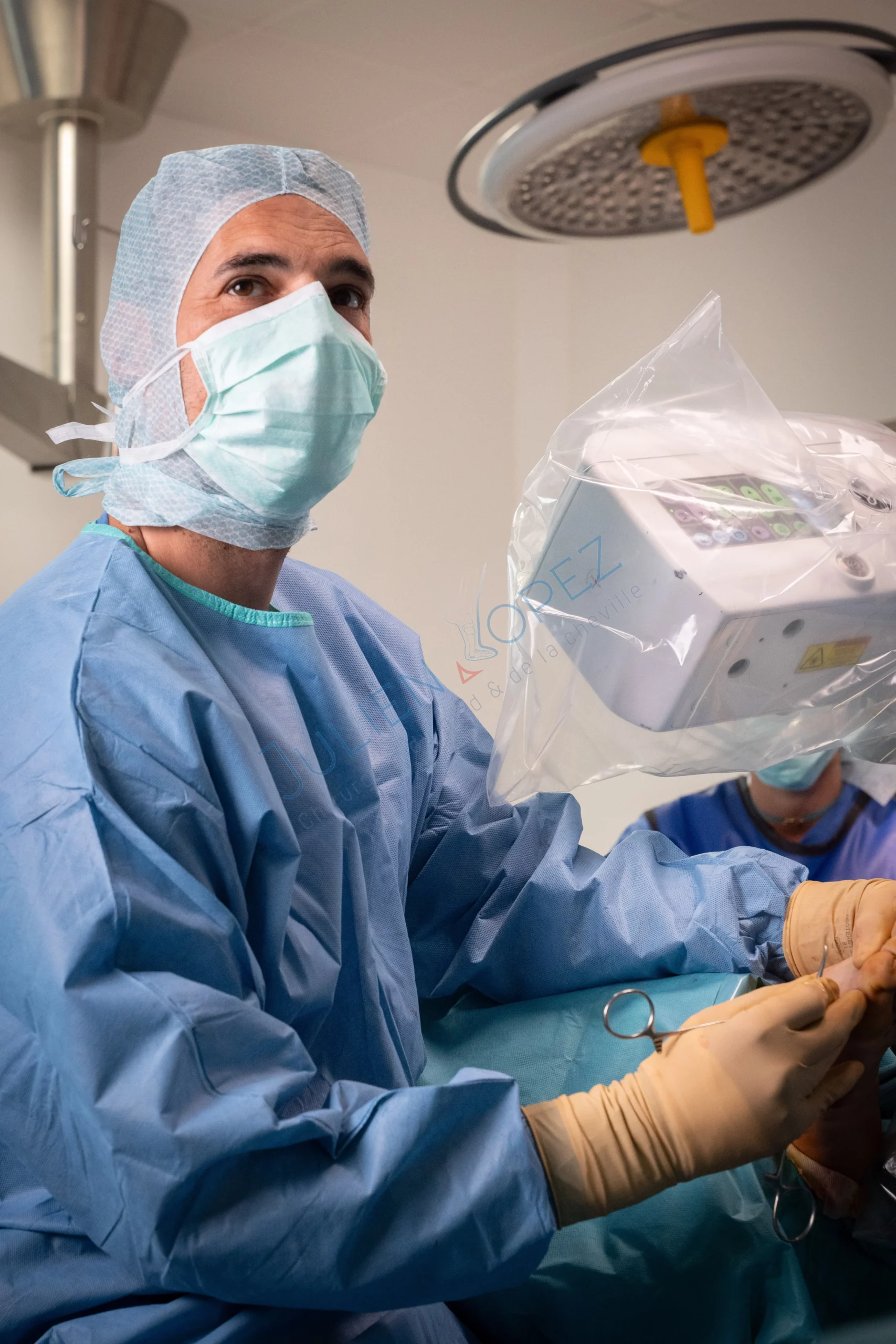
The Achilles Tendon Operation is carried out by a surgeon specialising in foot and ankle surgery. The technique chosen depends on the type of rupture (recent or old, partial or complete) and the patient’s profile.
A pre-operative consultation confirms the surgical indication, reviews imaging studies and explains the chosen strategy in detail. Anaesthesia may be general or regional. In most cases, the procedure is performed on a day-case basis.
The minimally invasive percutaneous technique involves making small incisions to bring together and suture the tendon ends using specialised instruments. This approach limits tissue disruption, reduces skin complications and promotes faster recovery.
In certain situations (complex rupture, chronic injury or significant retraction), a larger open incision may be necessary to visualise the tendon directly and carry out a precise repair or reconstruction. Broken Achilles tendon surgery of this type may include flap techniques or tendon transfer when there is substantial tissue loss.
The average operating time is approximately one hour, depending on the complexity of the injury.
A protective boot is fitted at the end of surgery to immobilise and safeguard the repair. Weight-bearing permissions (allowed or not) are determined by the surgeon according to the technique used.
A pain-management protocol is prescribed to ensure optimal comfort during the first days.
Achilles Tendon Surgery Recovery: Post-Operative Course and Expected Outcomes
The Achilles Tendon Surgery Recovery is progressive and supervised. The aim is to allow solid healing, limit the risk of complications and optimise functional recovery. Rehabilitation and surgery go hand in hand to ensure a fully functional tendon.
Following the procedure, a protective boot immobilises the ankle and secures the tendon suture. Depending on the technique and the patient’s profile, weight-bearing may be temporarily restricted or gradually permitted. This initial phase typically lasts 3 to 6 weeks, allowing the tendon to begin healing under optimal conditions.
A pain-relief protocol is prescribed; post-operative discomfort is usually well controlled.
After the protection phase, the boot is progressively removed and weight-bearing is reintroduced in a controlled manner. Achilles tendon operation recovery involves prescribed rehabilitation to:
- restore ankle mobility,
- progressively strengthen the calf,
- improve balance and stability.
Near-normal walking is generally achievable by the third month. Gentle physical activities such as swimming or cycling can be introduced progressively from the third month. More intense activities (running, team sports, skiing, tennis, etc.) are usually cleared between the sixth and eighth month, after medical validation.
The ultimate goal of torn Achilles tendon treatment by surgery is to achieve a stable functional recovery, including:
- restoration of tendon continuity and strength,
- a significant improvement in foot push-off power,
- a progressive return to everyday and sporting activities.
In the vast majority of cases, patients regain a satisfying active lifestyle. A slight difference in strength or endurance compared with the uninjured side may occasionally persist, particularly in elite athletes, but this is generally well tolerated.
The quality of outcomes depends closely on the precision of the surgical procedure, adherence to post-operative instructions and the regularity of rehabilitation. Rigorous medical follow-up supports each stage of recovery and allows the protocol to be adapted to the patient’s personal goals.
Treatment for Achilles Tendonitis: When Surgery Is Not Needed
Not all Achilles tendon problems require an operation. Treatment for Achilles tendonitis, which is an inflammation of the tendon without a full tear, is typically conservative in the first instance. Options include:
- rest and activity modification,
- targeted physiotherapy and eccentric strengthening exercises,
- orthotic insoles or heel lifts,
- anti-inflammatory medication,
- extracorporeal shockwave therapy in selected cases.
Achilles tendon problems treatment is always tailored to the individual. Surgery is only considered when conservative measures have failed to provide lasting relief and the tendon condition continues to impair function.
Achilles Tendon Rupture Treatment: Surgical or Conservative?
Achilles tendon rupture treatment can follow a surgical or a conservative pathway. The decision depends on the type and extent of the rupture, the patient’s age, activity level and functional goals.
Conservative (non-surgical) management may be appropriate for certain patients with a complete rupture, particularly older or less active individuals. It involves immobilisation in a boot with a gradual reduction of the equinus position, followed by structured rehabilitation.
However, surgical repair is generally preferred for active patients and athletes, as it offers a lower re-rupture rate and a more predictable recovery of strength and function.
At International Elite Care, the choice between surgical and conservative management is made jointly with the patient, based on a thorough specialist assessment.
Your Achilles Tendon Surgery Questions Answered
Is the procedure painful?
The operation is performed under anaesthesia, and a tailored pain-management protocol is applied post-operatively. Pain is generally well controlled and diminishes progressively over the first days. Attentive medical support allows adjustments if needed, ensuring optimal comfort throughout recovery.
What are the risks of the Achille Tendonitis Surgery?
As with any surgery, the procedure carries risks including infection, scarring issues or thromboembolic events. However, these complications remain uncommon when the operation is performed by a specialist Achilles tendon surgeon in a structured medical environment. Rigorous pre-operative assessment and attentive follow-up help to safeguard the entire pathway.
Can I come from abroad for the procedure?
Yes. International Elite Care specifically supports international patients. A pre-operative video consultation allows your medical records to be reviewed remotely. The team then organises your travel, hospitalisation and follow-up, ensuring a smooth and secure pathway even if you live abroad.
How long must I stay on site after the Achilles Tendon Rupture Operation?
The stay is generally short. The procedure is most often carried out on a day-case basis. A post-operative monitoring period is scheduled before your return, and coordinated remote follow-up can be arranged to ensure continuity of care in your country of residence.
How am I matched with the right surgeon?
Simply contact the International Elite Care team. After analysis of your medical records and functional goals, you will be directed to the most qualified and promptly available expert surgeon. This personalised approach ensures a bespoke strategy, adapted to your activity level and expectations.
Surgeon performing the procedure


Full support
Take advantage of our all-in-one service: insurance, travel, post-operative follow-up, etc.
Ready to begin your pathway?
From your country of residence, benefit from a teleconsultation with an expert surgeon and coordinated care in France or Andorra, with every detail of your medical stay carefully organised.