
Arthroplasty surgery of the knee
Arthroplasty surgery of the knee aims to treat joint damage in the knee, relieve pain and restore full function. Expert care at IEC.
At International Elite Care, this procedure is performed by recognised specialists in knee prosthetic surgery, with dedicated expertise for international patients seeking the highest standards of surgical precision and personalised care.
Knee arthroplasty is, by definition, the placement of prosthetic implants in the knee. The procedure involves removing the worn joint surfaces (damaged cartilage and altered bone) and replacing them with custom-fitted implants, in order to recreate a stable, smooth and fully functional joint.
Indications for arthroplasty of the knee
Arthroplasty of the knee is recommended when the damage becomes severe, painful and disabling, and when medical treatments can no longer provide acceptable comfort. It is a surgical procedure that:
- Removes the damaged joint surfaces
- Replaces these surfaces with prosthetic implants
- Restores stability and mobility to the knee
- Eliminates pain
The goal is to regain comfortable walking and significantly improve the patient’s quality of life.
At International Elite Care, the decision is always made following a thorough clinical assessment, a complete radiological evaluation and an in-depth discussion with the patient. Below are the different situations that may warrant a knee arthroplasty.
The primary indication is advanced cartilage wear, resulting in:
- Complete loss of joint space
- Progressive deformity of the knee (varus or valgus)
- Damage affecting one or more compartments of the knee
When the bone surfaces rub directly against each other, the mechanical pain is constant and debilitating.
Surgery is considered when:
- Painkillers and anti-inflammatory drugs no longer provide lasting relief
- Injections have become ineffective
- A walking stick has become necessary
- Pain occurs even at rest or during the night
- Functional impairment has a significant impact on the patient’s quality of life
The aim is not to operate on a minor inconvenience, but on pain that has become genuinely limiting in daily life.
Knee joint arthroplasty is indicated when mobility is compromised:
- Difficulty walking more than a few hundred metres
- Stairs are painful or impossible
- Marked stiffness in flexion or extension
- Significant reduction in social, professional or sporting activities
The decision is based as much on imaging findings as on the real impact on quality of life.
Some forms of knee arthritis lead to:
- Bow-legged knee (varus)
- Knock-kneed alignment (valgus)
- A sensation of instability
- Progressive loss of alignment
When the mechanical structure of the knee is compromised, surgery can restore a correct axis and lasting stability.
Arthroplasty is generally not recommended:
- In cases of early-stage arthritis
- If the pain remains moderate and well controlled
- If the functional impairment is minimal
- Without radiological confirmation
The surgical decision rests on three essential elements:
- Your actual pain and how it has evolved
- Your level of functional limitation
- The anatomical condition of your knee on imaging
At International Elite Care, a surgeon specialising in knee operations analyses these criteria to determine whether a partial or total arthroplasty is the most appropriate solution.
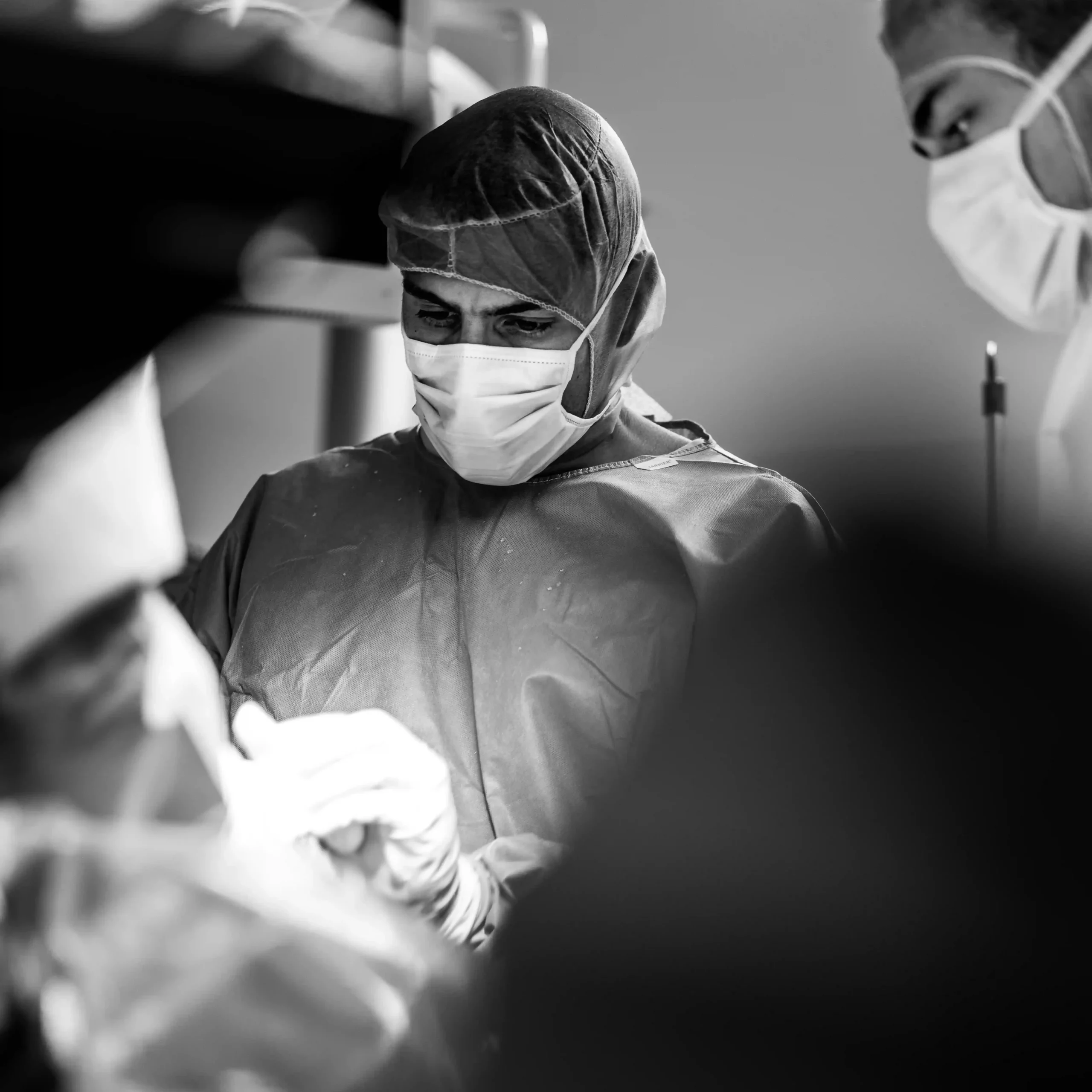
Knee arthroplasty procedure: the surgery step by step
The knee arthroplasty procedure is precise, well-codified and highly technical. The surgeons at International Elite Care use modern techniques and latest-generation prostheses for maximum comfort and a faster recovery.
The damaged ends of the femur and tibia are carefully removed. The areas of worn cartilage are precisely excised to prepare smooth bone surfaces ready to receive the implants.
This step is essential to ensure the stability and correct alignment of the knee.
Metal components (high-strength medical alloy) are fixed onto the femur and tibia. Between these two elements, a polyethylene insert (medical-grade plastic) is placed to act as a gliding surface. It provides:
- Smooth movement
- Reduced friction
- A supple and stable joint
A plastic component may also be placed on the kneecap, depending on intraoperative findings. Each prosthesis is selected according to the patient’s morphology and bone anatomy.
During the operation, computer-assisted navigation helps verify:
- Limb alignment
- Correct positioning of the implants
- Ligament balance
This contributes to the precision of the surgical procedure.
The muscle tissues are repositioned and the deep layers are closed with absorbable sutures. The skin is then brought together using surgical adhesive, which provides:
- A neat, harmonious scar
- Less tension on the skin
- Faster resumption of movement
The procedure lasts approximately one hour, and the hospital stay is generally between one and three days. After the operation, mobilisation begins very early, often on the same day or the day after surgery, under specialist supervision.
At International Elite Care, the surgery is part of a comprehensive, secure pathway that includes remote pre-operative preparation, premium on-site care and structured follow-up after your return home.
Partial knee arthroplasty: a targeted solution
Partial knee arthroplasty, also known as unicompartmental knee replacement, is a surgical procedure indicated when arthritis affects only a single area of the knee. Unlike widespread wear, some patients present with strictly localised damage:
- Medial compartment (the most common)
- Lateral compartment
- Patellofemoral compartment
In these specific cases, it is not necessary to replace the entire joint. The goal is to treat only the damaged zone while preserving the healthy structures.
The knee is divided into three compartments: medial tibiofemoral, lateral tibiofemoral and patellofemoral. When arthritis is limited to a single compartment, a partial replacement involves:
- Removing only the worn surfaces of the affected compartment
- Fitting a targeted implant
- Preserving the ligaments and any remaining healthy cartilage
The other compartments remain intact.
Unicompartmental knee replacement arthroplasty is considered when:
- The arthritis is strictly confined to a single compartment
- The ligaments (particularly the anterior cruciate ligament) are functional
- The limb alignment is relatively well preserved
- The pain corresponds precisely to the arthritic area
A thorough clinical examination combined with a complete radiological assessment confirms the indication. This is always personalised, as it depends on the exact location of the arthritis, the overall condition of the joint and the patient’s functional expectations.
Advantages of a partial prosthesis
Because it preserves a large part of the natural joint, unicompartmental replacement offers several benefits:
- Less invasive surgery
- Ligament preservation
- Sensations closer to a natural knee
- Often a faster recovery
- Generally very satisfactory post-operative mobility
For a well-selected patient, this procedure offers an excellent balance between lasting pain relief and respect for the anatomy.
At International Elite Care, every case is assessed individually. A pre-operative teleconsultation allows us to review your imaging remotely and determine whether you are a candidate for unicompartmental replacement.
Total knee arthroplasty: a complete reconstruction of the joint
Total knee arthroplasty is indicated when arthritis is severe and widespread, meaning it affects the entire joint. Several compartments are involved, the wear is generalised and the pain is significant.
In this situation, conservative treatments are no longer sufficient. With marked loss of joint function, it becomes necessary to replace all of the damaged joint surfaces.
A total knee arthroplasty with prosthesis comprises two main components:
- Femoral component (metallic)
- Tibial component (metallic)
Between the femoral and tibial pieces, a polyethylene insert is placed to provide a smooth and durable gliding surface.
The goal of bilateral knee arthroplasty or tricompartmental arthroplasty is to remove the worn bone and cartilage surfaces, then reconstruct a stable, well-aligned joint in order to restore comfortable mobility. Total knee arthroplasty enables:
- Correction of deformities (bow-legged or knock-kneed alignment)
- Restoration of limb axis
- Optimised joint stability
- Progressive elimination of pain caused by bone-on-bone friction
The modern implants used by the surgeons at International Elite Care are designed to offer durability, biomechanical precision and longevity.
Knee arthroplasty recovery: post-operative course and expected results
After surgery, knee arthroplasty recovery is progressive, supervised and carefully structured. At International Elite Care, the objectives are twofold:
- To secure the immediate post-operative phase
- To optimise functional outcomes in the medium and long term
The hospital stay is short and closely monitored, typically lasting one to three days. From the first day, the patient may stand with assistance, and weight-bearing is permitted.
Following total knee arthroplasty recovery, supervised rehabilitation begins early, and pain is rigorously managed with a tailored analgesic protocol. To support recovery after knee arthroplasty, regular nursing care can be arranged.
During this period, the patient may frequently experience a sensation of tightness and moderate swelling around the operated area. The situation improves gradually over several weeks and pain medication continues as needed.
Ongoing rehabilitation is essential in order to:
- Regain full knee extension
- Gradually recover flexion
- Reactivate and strengthen the thigh muscles
- Restore a smooth walking pattern
Walking with crutches is often necessary for two to four weeks, then gradually phased out.
The typical knee arthroplasty recovery time milestones are as follows:
- Comfortable independent walking: 4 to 6 weeks
- Driving: approximately 1 month (depending on which side was operated)
- Normal daily activities: 6 to 8 weeks
- Gentle sporting activities (cycling, swimming, golf): after 3 months
Superficial wound healing after knee arthroplasty typically takes around two to three weeks. The scar reaches its final appearance over several months.
In the vast majority of cases, arthritic pain gradually disappears. The mechanical pain caused by bone rubbing against bone is eliminated.
Mobility is improved, with easier movement and greater comfort in daily activities. Walking is more stable and any pre-existing deformity (knock-kneed or bow-legged) is corrected. Patients generally describe:
- A return to getting about freely
- Restored independence
- A significant improvement in daily comfort and quality of life
Modern prostheses have an impressive lifespan. They are designed to function for many years, provided there is regular follow-up and an appropriate lifestyle.
For patients travelling from abroad, International Elite Care arranges revision knee arthroplasty follow-up care and rehabilitation with remote digital monitoring until full recovery is achieved.
Our answers to your questions about knee arthroplasty
How long does knee arthroplasty surgery take?
The duration of knee surgery with prosthesis placement depends on your initial state of health and the surgical technique chosen. On average, the procedure takes between 45 minutes and one hour.
How long will I be in pain?
As a general rule, pain is well controlled by analgesic medication, but it may persist for various reasons. Initially, the pain may be linked to bruising.
Seven to ten days after a total knee arthroplasty (or partial), pain may return due to the post-operative inflammatory rebound phenomenon.
The pain may also relate to the prosthesis settling into your joint. These residual pains diminish over time and, as a general rule, disappear completely once the new joint has sufficiently stabilised.
I have bruising all along my leg and my leg is swollen after knee arthroplasty. Is this normal?
Bruising is common and is caused by the bone cuts made during placement of the knee prosthesis. As long as the tissues remain soft, the bruising is not a cause for concern. Apply ice packs several times a day to relieve discomfort and reduce swelling and bruising.
When can I walk without a stick after knee arthroplasty?
There is no fixed rule, as it varies from person to person. Some patients try walking without a stick from the very first day; others may need one for 8, 15 or even 45 days.
In general, the patient can manage with a single stick (on the opposite side to the operated knee), then stop using it indoors, and finally outdoors. Driving is possible once the patient can walk comfortably without any support.
When can I drive after a knee replacement?
As a general rule, it is possible to resume driving after about one month. However, the patient must ensure their faculties are at their best and must not drive under the influence of opioid-based medication. International Elite Care provides structured follow-up after knee arthroplasty to guide the patient through every stage of recovery and answer all their questions.
When can I return to work or sport?
This depends on your occupation and your level of physical activity before surgery. The total knee arthroplasty recovery time before returning to professional or sporting activities typically ranges from three to six months.
Surgeon performing the procedure


Full support
Take advantage of our all-in-one service: insurance, travel, post-operative follow-up, etc.
Ready to begin your care pathway?
From your country of residence, benefit from a teleconsultation with an expert surgeon and coordinated care in France or Andorra, with every detail of your medical stay carefully organised.