
Knee replacement
Knee replacement is a surgical procedure that involves replacing all or part of the knee joint with artificial implants. These implants are designed to closely replicate the natural function of the joint.
The prosthesis is typically made from high-quality metal alloys and biomedical materials that are fully tolerated by the body. It restores knee mobility, provides lasting pain relief and significantly improves the patient’s quality of life.
There are different types of knee prostheses (partial or total), selected by the surgeon based on the extent of joint damage, the patient’s anatomy, age, activity level and functional expectations.
This procedure is one of the most well-established orthopaedic surgeries performed today, with reliable outcomes when carried out by experienced knee replacement surgeons.
Types of prostheses: total knee replacement and unicompartmental replacement
Total knee replacement is recommended when the joint has suffered lasting damage and non-surgical treatments no longer provide effective symptom relief.
This differs from a partial replacement, which is used when the damage is limited to a single compartment of the knee.
Full knee replacement
Full knee replacement is indicated when the entire joint is affected, most commonly as a result of advanced knee osteoarthritis.
It is primarily intended for patients presenting with:
- Chronic knee pain, present at rest or during activity
- Advanced cartilage wear (knee osteoarthritis)
- Significant joint stiffness affecting everyday movements
- A marked reduction in mobility and independence
The procedure involves replacing the worn joint surfaces with implants that reproduce the anatomy and function of the knee. The goal is to relieve pain, restore mobility and improve overall function.
Unicompartmental / partial knee replacement
When only part of the joint is affected, a unicompartmental / partial knee replacement may be considered.
This is a half knee replacement that replaces only one compartment of the knee (medial, lateral or patellofemoral), while preserving the ligaments and healthy joint surfaces.
This option may be suitable for patients presenting with:
- Osteoarthritis localised to a single compartment
- Functional ligaments
- Moderate deformity
- Good bone stock
The main advantage lies in the more conservative nature of the procedure: a smaller incision, often faster recovery and a sensation closer to a “natural” knee.
However, this option requires careful patient selection to ensure a lasting result.
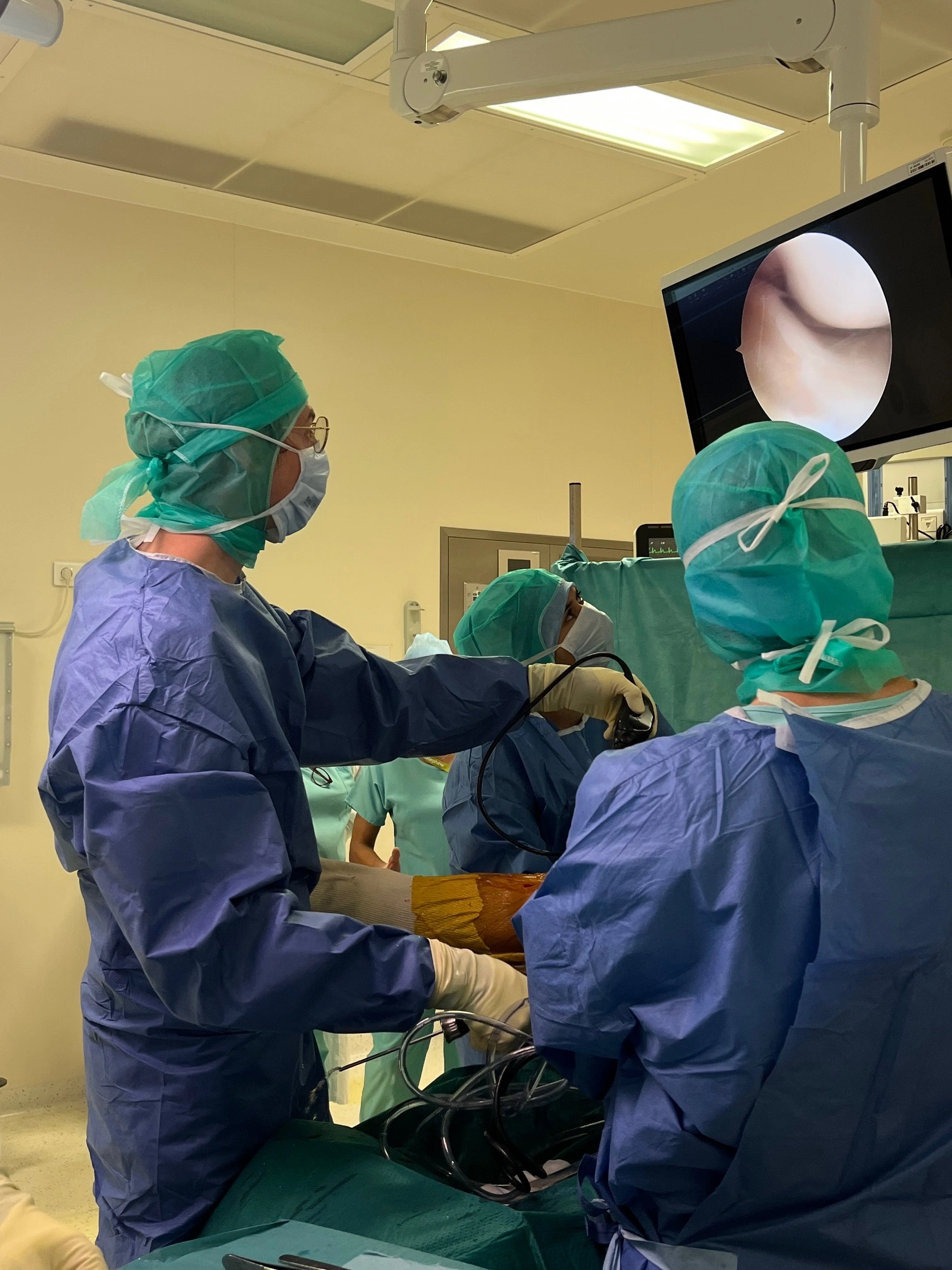
How knee replacement surgery is performed
Knee replacement surgery is an orthopaedic procedure that follows a rigorous protocol tailored to each patient.
Before the knee replacement operation, a thorough assessment is carried out: clinical examinations, medical imaging, blood tests and an anaesthetic review. For patients travelling from abroad, International Elite Care makes it possible to prepare this stage remotely via teleconsultation.
Anaesthesia and joint access
The procedure, whether for a complete knee joint replacement or a partial replacement, is most commonly performed under regional anaesthesia (spinal anaesthesia), sometimes combined with light sedation. This technique provides effective pain control and supports a faster recovery. The choice of anaesthesia is personalised and discussed with the anaesthetist.
The surgeon accesses the joint through a precise incision. The surrounding muscle structures are carefully preserved to protect the tissues and support a smoother postoperative course.
The aim is to prepare a clean and perfectly adapted site for the prosthesis, while respecting the natural alignment of the leg.
Placement of the prosthesis
During knee surgery, the prosthetic components are positioned to replace the damaged joint surfaces and allow smooth, stable movement of the knee. Depending on the case, the surface of the kneecap may also be resurfaced based on preoperative findings.
The surgeon then checks the stability, alignment and range of motion of the joint. Once these elements have been confirmed, the incision is carefully closed.
The procedure typically lasts around one hour.
Knee replacement recovery: what to expect after surgery
Knee replacement recovery is now well managed thanks to modern rehabilitation protocols and effective pain management.
After surgery, the patient is transferred to the recovery room and then to their ward. Pain is closely monitored and managed with tailored treatments to ensure optimal comfort from the very first hours.
Knee mobilisation begins quickly, usually on the same day or the day after surgery, with the support of a physiotherapist. This early return to movement promotes smoother knee replacement healing and reduces the risk of complications.
The average hospital stay is one to three days.
Functional rehabilitation and return to independence
Rehabilitation begins within the first few days following the procedure. It plays a key role in restoring mobility, strength and stability. The goals include:
- Gradually restoring knee mobility
- Reactivating the thigh muscles
- Improving stability and walking
- Regaining independence safely
For international patients, a rehabilitation programme can be arranged on site or coordinated with healthcare professionals in the patient’s home country, with remote medical follow-up if needed.
Weight-bearing is generally allowed soon after surgery, whether following a total or partial knee replacement. The return to daily activities happens gradually over the first few weeks.
Driving can typically be considered around one month after surgery, depending on the type of prosthesis, the side operated on and the patient’s functional progress.
Regular medical follow-up ensures the recovery from knee replacement stays on track and allows adjustments to be made where necessary.
Expected results after a next-generation knee replacement operation
A next-generation knee replacement operation delivers, in the vast majority of cases, a clear and lasting improvement in quality of life. Results depend on the initial indication, the quality of the surgery, the rehabilitation programme and the patient’s commitment to their care pathway.
One of the primary benefits of knee replacement is a significant reduction, and in many cases the complete resolution, of joint pain caused by knee wear. The mechanical pain that once limited walking, daily movement or sleep is gradually replaced by a more comfortable and stable joint sensation.
Knee replacement restores a functional range of motion that makes everyday activities easier: prolonged walking, going up and down stairs, and standing without discomfort. Mobility improves progressively over several weeks to a few months.
Most patients regain a satisfactory level of independence and can resume their usual activities without excessive pain. Low-impact activities such as walking, swimming, cycling and golf are generally permitted and encouraged after full knee replacement recuperation.
Modern prostheses are built to last, with a typical lifespan of at least 15 to 20 years. The durability is comparable whether the patient has received a partial or a total replacement. Regular medical check-ups allow the long-term condition of the implant to be monitored.
Our answers to your questions about knee replacement
Am I a good candidate for knee replacement?
The decision to proceed with knee replacement is made on a case-by-case basis, as it depends on many factors: the severity of the pain, functional impairment, imaging results, overall health and personal expectations. A specialist consultation will determine whether this approach is appropriate for your situation or whether other options should be explored.
What is the minimum age for knee replacement?
There is no strict age limit for knee replacement. The procedure is most commonly performed on patients over the age of 60, but it may be recommended earlier when functional impairment is significant and quality of life is affected. The decision is based above all on the condition of the knee, the patient’s lifestyle and their individual needs.
Is knee replacement a painful procedure?
Modern anaesthesia and postoperative care techniques allow for effective pain management. While some discomfort is normal after surgery, it is anticipated and managed through tailored protocols designed to ensure optimal comfort and a smooth recovery.
What is the knee replacement recovery time before I can travel home?
With International Elite Care, the length of your stay is arranged on a personalised basis. It includes hospitalisation, the initial days of rehabilitation and the postoperative check-ups required before your return. On average, a stay of a few days to two weeks should be expected, depending on the patient’s profile and the type of care selected. Your knee replacement recuperation time will be discussed with your surgeon to plan your journey home safely.
Can I travel after knee replacement?
Yes, travelling is perfectly possible after knee replacement, whether total or partial, provided it is planned within a timeframe compatible with your recovery. The International Elite Care medical team supports you in planning your return, taking into account your mode of transport, journey duration and the precautions to follow.
How safe is knee replacement surgery?
Knee replacement is one of the most widely performed and well-established orthopaedic procedures. When carried out by experienced surgeons in facilities that meet high medical standards, it offers an excellent level of safety. Every patient undergoes a thorough assessment to minimise risks and optimise outcomes.
Will I receive follow-up care after returning to my country?
Yes. Postoperative follow-up is a key part of the International Elite Care pathway. It can be provided remotely through teleconsultation, in coordination with local healthcare professionals where needed. This continuity of care helps to safeguard your recovery and maintain a clear framework after your return.
What should I expect before and after knee replacement surgery?
Before surgery, a full medical assessment is carried out, including imaging, blood tests and an anaesthetic review. After the procedure, you can expect a structured recovery plan with physiotherapy, pain management and regular check-ups to support your return to everyday life.
What is the knee replacement cost with International Elite Care?
The knee replacement cost depends on several factors, including the type of prosthesis (total or partial), the length of the hospital stay and any additional services required. International Elite Care provides a personalised quote after your initial consultation, so you have full visibility of the private knee replacement cost before making any commitment. The team is available to discuss financing options and guide you through the process.
Why choose International Elite Care for my knee replacement?
International Elite Care gives you access to recognised surgical expertise alongside personalised support at every stage. The team connects you with the best knee replacement surgeons for your specific situation, while organising your entire medical stay from start to finish.
Surgeon performing the procedure


Full support
Take advantage of our all-in-one service: insurance, travel, post-operative follow-up, etc.
Ready to begin your journey?