
Cartilage transplant knee surgery
Cartilage transplant knee surgery helps restore damaged knee cartilage, relieve pain and support smoother daily joint movement and recovery.
Cartilage is a smooth, resilient tissue that covers the surfaces of the joint. It allows pain-free, fluid movement. When cartilage is damaged following a trauma, a sports injury, or localised wear, it does not regenerate on its own.
A cartilage transplant for knee injuries is designed to restore a functional joint surface, reduce pain, improve mobility, and preserve the knee over the long term, particularly in active or relatively young patients.
This surgery targets well-defined, localised cartilage lesions and requires expert, personalised assessment to determine the most suitable strategy based on the knee’s condition, the patient’s age, and their level of activity.
Indications for cartilage transplant in knee
Cartilage transplant in knee joints is indicated for patients with a localised cartilage lesion causing persistent pain and functional impairment, despite a well-conducted course of non-surgical treatment.
It is a viable surgical option in certain cases of knee chondropathy, where the cartilage damage is localised and can be repaired.
A cartilage transplant is generally recommended in the following situations:
- Focal cartilage lesion of the knee (cartilage destroyed over a specific area)
- Persistent mechanical pain after failure of conservative treatments
- Active patient
- No advanced, diffuse osteoarthritis (the damage is highly localised and does not affect the entire knee)
- Stable and well-aligned knee
Knee cartilage transplant is often necessary following traumatic injuries or sports accidents. It may also be indicated after a previous knee surgery or in the case of localised damage to the femoral, patellar, or tibial cartilage.
Addressing knee chondropathy through a cartilage knee transplant is another possible scenario, provided specific criteria are met. This is why a specialist consultation with an expert knee surgeon is essential.
At International Elite Care, the decision to proceed with a cartilage transplant always rests on a thorough, personalised analysis: clinical examination, specialist imaging (MRI), activity level, the patient’s expectations, and life goals.
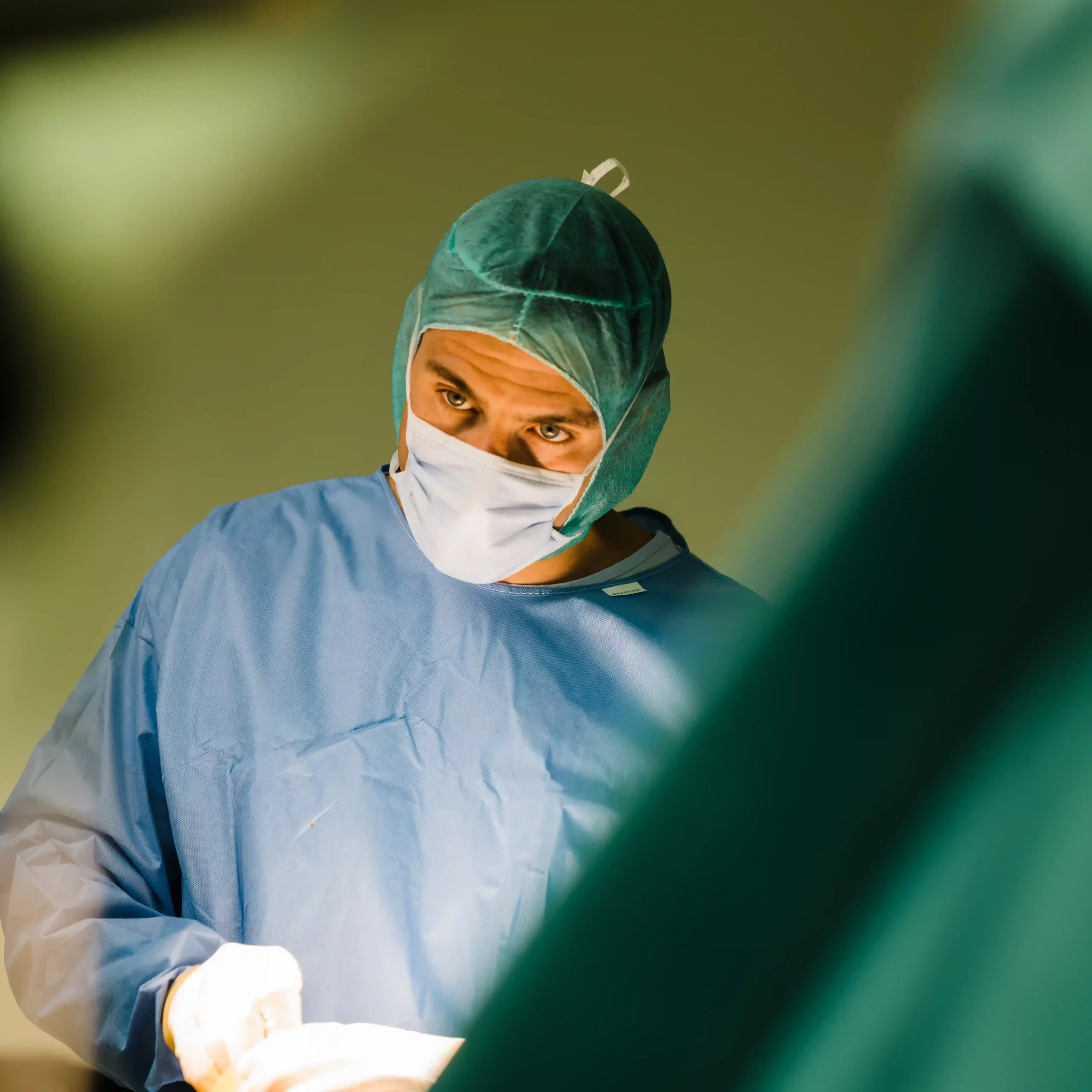
Cartilage transplant for knee: understanding the surgery
Cartilage transplant for knee is performed in a specialist medical environment. Every step is carefully planned to ensure precision, optimal safety, and a lasting result.
Before surgery
Before the operation, the patient undergoes a complete, tailored assessment:
- specialist consultation (often available via video consultation),
- detailed analysis of imaging (MRI, X-rays),
- knee assessment (stability, alignment, overall cartilage condition),
- discussion of expectations, lifestyle, and functional goals.
This phase confirms the indication and determines the graft technique best suited to the lesion.
Stages of surgery
Here is how cartilage transplantation knee surgery is carried out.
The procedure is performed under regional or general anaesthesia, depending on the case, and takes an average of 20 minutes. Depending on the technique chosen, the surgeon may access the joint via arthroscopy (minimally invasive surgery) or through a targeted incision when the graft requires direct exposure.
The main steps are:
- Precise preparation of the damaged area
- Placement of the graft
- Stabilisation of the graft
- Final inspection of the joint surface
After surgery
After the procedure, the patient is taken to the recovery room and pain is carefully managed.
Knee mobilisation begins early after the operation, in a gradual and supervised manner.
Following a cartilage transplant in the knee, recovery is generally swift, often just a few days, depending on the technique used and the organisation of the medical stay.
Knee cartilage transplant recovery time and post-operative care
The knee cartilage transplant recovery time and post-operative care play a major role in the quality of cartilage healing and the long-term functional outcome. A precise, progressive protocol is systematically put in place.
In the first hours and days:
- pain is usually moderate and well controlled with appropriate medication,
- some swelling of the knee is common and temporary,
- the knee is protected to encourage graft integration.
A brace may be prescribed depending on the location of the lesion and the technique used.
Partial weight-bearing may be required for several weeks, with the help of crutches.
Knee mobilisation begins early, gently and under supervision, to preserve joint flexibility without compromising the graft.
The range of movement is increased gradually, following a personalised protocol. These measures protect the grafted cartilage while preventing stiffness.
Even during the recovery period, a knee cartilage transplant rehab programme requires regular joint mobilisation. This is why rehabilitation is essential and carefully planned:
- it begins shortly after the procedure,
- it is carried out under the supervision of specialist professionals,
- it combines mobility work, muscle strengthening, and movement control.
The duration of rehabilitation varies depending on the technique used, the size of the lesion, and the patient’s profile, but generally extends over several months.
Light daily activities can be resumed gradually, based on the surgeon’s recommendations and the patient’s own feelings.
A return to sport is considered progressively, typically between 3 and 12 months, depending on the type of sport and clinical progress.
High-impact activities (running, football, rugby, tennis, skiing, etc.) are only permitted after medical clearance.
Regular follow-up is organised to:
- monitor the knee’s progress,
- adjust the rehabilitation programme,
- support the patient through to optimal return to their activities.
For international patients, this follow-up can be partly coordinated remotely by International Elite Care, using digital tools and close communication with local teams.
Knee cartilage transplant success rate and expected results
The knee cartilage transplant success rate is encouraging: the procedure aims to deliver a lasting improvement in joint function by treating the cause of the pain rather than just managing symptoms. Results depend on several factors, including the size and location of the lesion, the technique used, and adherence to the post-operative protocol.
Pain relief
A significant reduction in pain is generally observed over time. Relief is not immediate: it develops progressively over the months as the grafted cartilage integrates.
Mechanical pain linked to movement and daily activities is often markedly reduced.
Improved mobility and function
The knee regains better flexibility and functional stability. Everyday activities such as walking, climbing stairs, and prolonged movement become more comfortable.
A gradual return to physical and sporting activities is possible, depending on the patient’s profile and the type of sport practised.
Long-term preservation of the knee
One of the primary goals of the transplant is to slow the progression of joint wear.
By restoring a functional cartilage surface, the graft helps preserve the joint and delay the need for more invasive solutions.
Our answers to your questions about knee cartilage transplant surgery
Am I a good candidate for a cartilage transplant for knee damage?
A cartilage transplant for knee damage is suited to very specific situations and is not a universal solution.
A specialist assessment is essential to determine whether this procedure is appropriate for your knee, your age, your activity level, and your goals.
At International Elite Care, this analysis can begin remotely, through an in-depth review of your medical records and imaging, so that you can be guided towards the most suitable strategy without delay.
What is the knee cartilage transplant surgery recovery time?
The knee cartilage transplant surgery recovery time varies depending on the technique used and the size of the lesion. Most patients can expect to resume light daily activities within a few weeks. Full recovery, including a return to sport, generally takes between 3 and 12 months. A tailored rehabilitation programme and regular follow-up are key to achieving the best possible outcome.
Are knee cartilage transplants effective?
Knee cartilage transplants are effective in the majority of patients, with excellent short- and medium-term clinical results in relieving pain and restoring near-normal joint function, particularly for small lesions in young, active individuals.
Is the cartilage transplant painful after the operation?
A cartilage transplant typically causes some pain in the days following the operation, but this discomfort is generally well managed with painkillers and appropriate post-operative care.
What is the best clinic for knee cartilage transplant surgery?
The quality of a knee cartilage transplant surgery depends above all on the surgeon’s expertise, the technical facilities, and the rigorous selection of indications. International Elite Care identifies the centre and specialist best suited to each patient’s situation, within institutions recognised for their high standards in knee surgery.
Why choose International Elite Care for this type of surgery?
International Elite Care gives you access to high-level surgical expertise, within a demanding medical framework, while benefiting from personalised support at every stage. International Elite Care connects you with a surgeon who is a specialist in cartilage transplant surgery knee procedures, and offers a reliable, seamless, and reassuring medical experience.
Surgeon performing the procedure


Full support
Take advantage of our all-in-one service: insurance, travel, post-operative follow-up, etc.
Ready to begin your journey ?