
Morton’s Neuroma
Morton’s neuroma is a forefoot condition caused by compression of a nerve at the base of the toes, affecting walking. This compression develops gradually. Over time, it leads to irritation and then thickening of the nerve, eventually producing intense pain.
Despite its swollen appearance, Morton’s neuroma is not a tumour. It is a defensive reaction of the nerve caused by chronic compression. The condition is progressive and can become a significant daily handicap without appropriate management.
Related treatment(s)
-
Morton’s Neuroma Surgery
See the treatment in detail

Morton’s Neuroma: Test and Diagnosis
A clinical Morton’s neuroma test, such as the Mulder’s click, is the gold standard for identifying nerve entrapment before moving to advanced imaging.
Morton’s neuroma is a tunnel condition. This means the problem occurs in a narrow anatomical space (a canal) through which a nerve passes. In the forefoot, the digital plantar nerves run between the metatarsals (the bones just behind the toes) and have very little room.
If these nerves thicken due to irritation, they are easily stimulated during walking, triggering immediate painful responses.
Morton’s Neuroma: Causes That Are Difficult to Pinpoint
The precise causes of Morton’s neuroma are still not fully understood. Some evidence suggests that the condition may result from a succession of micro-traumas (sports such as football, handball, tennis) and the wearing of narrow footwear. These situations can cause nerve compression, which may encourage the development of the condition.
Another theory considers the two functional components of the foot. The talar foot comprises the first three rays from the big toe and is responsible for propulsion. The calcaneal foot covers the last two rays and provides shock absorption. The up-and-down movement between these two components creates shearing forces that promote nerve irritation and neuroma formation.
Morton’s neuroma is diagnosed more frequently in women, particularly from the age of fifty onwards, often around the peri- or post-menopausal period.
Diagnosis of Morton’s Neuroma Pathology
The diagnosis of Morton’s neuroma is based above all on a rigorous clinical assessment, carried out by an experienced surgeon specialising in foot conditions.
The first step is a thorough clinical examination of the foot. The surgeon performs targeted palpation of the forefoot, looking for pain that is:
- very sharp,
- clearly localised,
- reproducing exactly the discomfort felt during walking,
A specific test known as the Mulder test is then performed. It involves compressing the forefoot transversely, looking for typical clinical signs such as the characteristic pain of Morton’s neuroma.
To confirm the diagnosis and rule out other causes of pain, imaging studies may be requested:
ultrasound, often preferred as it is more reliable than MRI for visualising the neuroma.
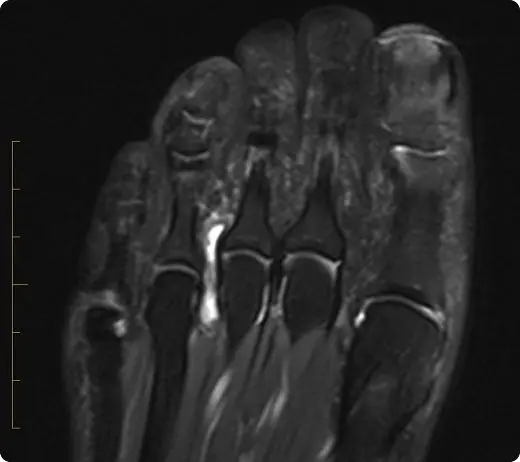
These supplementary investigations are not always necessary when the symptoms are sufficiently clear.
In all cases, the diagnosis takes into account:
- the precise location of the affected nerve (e.g. Morton’s neuroma at the big toe),
- the severity of symptoms,
- the morphology of the foot and the mechanical stresses involved.
The approach is individualised to ensure Morton’s neuroma is treated with the most appropriate method, whether medical or surgical.
Morton’s Neuroma: Symptoms and Clinical Presentation
Morton’s neuroma’s symptoms are numerous, their severity varies depending on the patient and the stage of progression. These symptoms may appear in isolation or together.
The most common symptoms are:
- Sharp, acute pain beneath the forefoot, often during walking or weight-bearing
- An electric shock-like sensation in the toes
- Numbness or tingling in the toes
- A need to remove shoes and massage the forefoot
These are typically mechanical symptoms: they appear during weight-bearing and walking, when the nerve is subjected to physical stress. They are aggravated by tight or high-heeled shoes and diminish or disappear at rest.
As soon as any of these symptoms appears, it is advisable to consult a foot and ankle specialist. Early management makes it possible to confirm the diagnosis, relieve the neuroma and slow the progression of the condition.
Morton’s Neuroma Disease: Personalised Treatment
For Morton’s neuroma disease, management is progressive and personalised. It always begins with non-surgical options, before surgery is considered should the pain persist or become disabling.
The International Elite Care surgeon tailors each treatment according to the severity of symptoms, the degree of nerve thickening and the patient’s lifestyle. This makes it possible to determine the optimal approach.
Before any surgery, several options may be proposed to relieve pain while limiting the progression of the condition:
- Physiotherapy
- Orthotic insoles (custom-made plantar orthoses)
- Footwear adaptation (wide, well-fitting shoes)
- Corticosteroid injections (to reduce inflammation and pain)
Surgery for Morton’s Neuroma
In approximately 80% of cases, conservative treatments are insufficient. A surgical approach may then be proposed. It is tailored according to:
- the degree of nerve involvement,
- the extent of nerve thickening,
- the clinical and radiological assessment.
The International Elite Care surgeon favours minimally invasive or percutaneous techniques. These methods preserve tissue, optimising recovery and simplifying post-operative care.
Among these is neurolysis, which involves releasing the compressed nerve by cutting the ligament responsible for the compression. This procedure is performed through an open approach or percutaneously, with an incision of approximately 2 mm. The risk of failure and persistent pain is significant; this technique is generally reserved for smaller neuromas.
Another technique involves performing osteotomies on the metatarsal heads using percutaneous surgery. In cases where the metatarsal bones are excessively long, this corrects the weight-bearing pattern, reduces mechanical stress and decompresses the nerve.
In cases of significant nerve thickening, the nerve may have become too bulky and damaged to be treated by neurolysis alone. In such cases, nerve resection (neurectomy) may be performed. This means surgically removing a portion of the nerve to eliminate the pain permanently.
This procedure results in permanent loss of sensation at the tips of the affected toes, without affecting their mobility, muscular strength or stability.
Your Morton’s Neuroma and Foot Conditions Questions Answered
The expert surgeons at International Elite Care answer all your questions about Morton’s neuroma and foot conditions.
What is Morton’s neuroma?
Morton’s neuroma is a painful thickening of the tissue around a nerve in the ball of the foot, usually between the 3rd and 4th toes (third web space), caused by compression from tight shoes, high heels, or foot stress.
It leads to burning/sharp pain, tingling, numbness, or a “pebble in shoe” sensation during walking, worsened by activity but eased by rest or massaging.
Can Morton’s neuroma be cured?
Yes, Morton’s neuroma can often be cured, especially with early intervention. Conservative treatments like wide shoes, metatarsal pads, orthotics, and corticosteroid/alcohol injections resolve symptoms in most of early cases by reducing nerve compression and inflammation.
Does Morton’s neuroma require surgery?
No. Many patients achieve relief through non-surgical treatments when these are introduced early enough and appropriately. Surgery is only considered when pain persists despite well-managed conservative treatment. When indicated, it is proposed thoughtfully, using modern techniques designed to minimise post-operative effects and to accelerate recovery.
Is the procedure painful?
Current techniques, particularly minimally invasive ones, significantly limit post-operative pain. Regional anaesthesia and prescribed pain management ensure satisfactory comfort during recovery. The majority of patients describe moderate, well-controlled pain that is very different from the pain experienced before the procedure.
How long before you can resume normal life after the procedure?
The return to everyday activities is progressive but quick. Desk-based work can typically be resumed within a few days, and driving is generally permitted after about a week, depending on pain levels. A temporary sensation of “walking on a lump” may persist for a few weeks: this usually corresponds to a post-operative haematoma and resolves spontaneously.
Can Morton’s neuroma affect both feet?
Yes, it is possible to have Morton’s neuroma in both feet, although this is less common. Each foot is assessed independently, as the condition may be asymmetrical in both severity and location. When both feet are affected, management is tailored on a case-by-case basis: the surgeon may propose bilateral conservative treatment, or decide to treat one foot first and then the other if necessary. This progressive approach helps to preserve the patient’s comfort and mobility.
Why consult a specialist centre like International Elite Care?
Managing Morton’s neuroma requires specific expertise in foot and ankle conditions, along with a strong command of minimally invasive techniques. International Elite Care offers personalised support, streamlined access to experienced surgeons and an organisation designed for international patients. This approach saves time, provides rapid access to expert opinion and ensures you are guided towards the most appropriate solution for your situation.
Surgeon performing the procedure

Full support
Take advantage of our all-in-one service: insurance, travel, post-operative follow-up, etc.
Ready to begin your care journey?